In Supreme Court tariff case, refunds would make ‘a measurable, immediate difference,’ business owners say
Challenges to Trump’s tariff program have reached the Supreme Court, and experts say it could force the administration to refund importers.
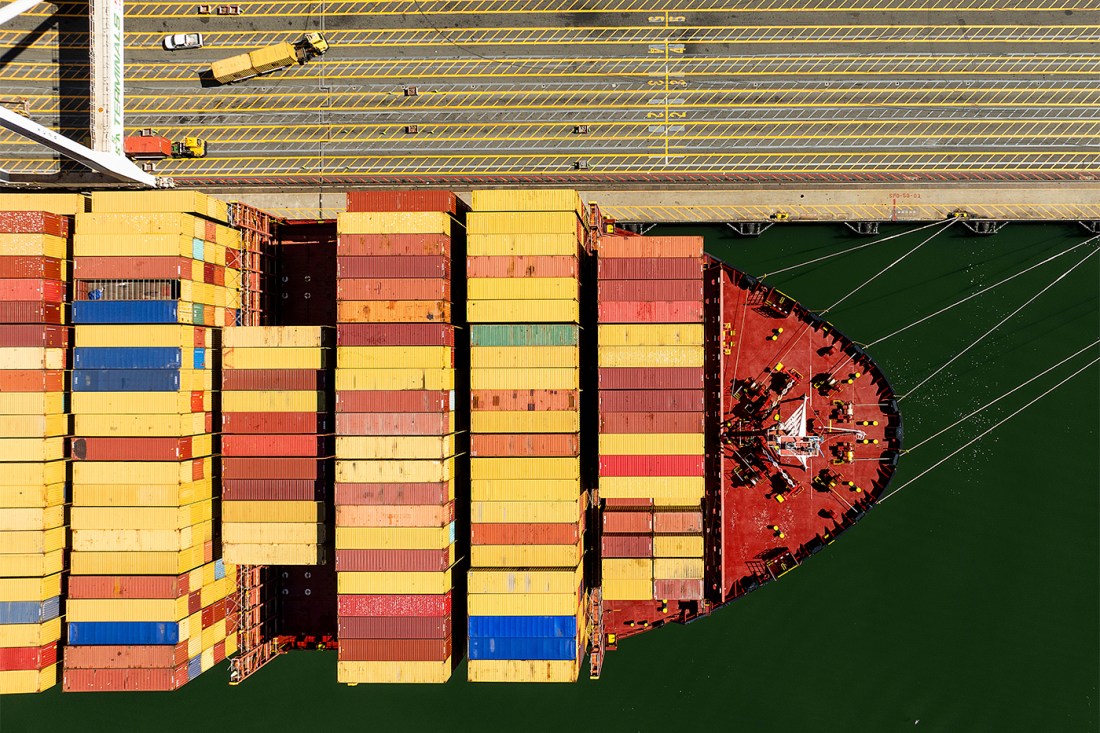


Shortly after taking office in January, President Donald Trump imposed dozens of new tariffs on imports, triggering legal action from numerous groups and businesses and rattling the global economy.
Challenges to Trump’s use of emergency powers in setting the tariffs have reached the Supreme Court, which could force the administration to refund importers an estimated $750 billion to $1 trillion in revenue, according to Treasury Secretary Scott Bessent.
It’s a question on everybody’s mind: If the court were to rule against Trump’s tariff program, would importers get refunds, or would the money stay in the government’s coffers? The outcome of the high-stakes case could reverberate far beyond trade lawyers and customs brokers — affecting businesses both in the U.S. and around the world, experts say.
“I hope that the tariffs are settled in a way that is fair and just for small businesses,” said Shawn Laughlin, founder and creative director of Caskata, a home goods provider in Massachusetts, and one of over 700 business owners who signed an amicus brief to the Supreme Court as it weighs the legality of Trump’s tariffs. “This was an unexpected tax on small businesses.”
The Trump administration has argued that issuing refunds would be “administratively burdensome” and chaotic. Trump is now proposing to send most Americans $2,000 pulled from revenue raised by his tariff program — a move that economists say may not be feasible.
Dan Urman, director of the law and public policy minor at Northeastern University, who teaches courses on the Supreme Court, said there is precedent for the government to issue “blanket duty refunds,” or broad, across-the-board repayments covering entire categories of imports.
Legal groups such as the Cato Institute, a Washington, D.C.-based libertarian think tank, have pointed out that the U.S. Customs and Border Protection, or CBP, the federal agency that collects import duties, has issued “broad, automatic refunds” before.
For example, when the Generalized System of Preferences, a program that lets certain imports from developing countries enter the U.S. duty-free, was renewed in 2018 and applied retroactively that year, CBP refunded duties on all eligible goods, including those that had already been processed, thanks to an automatic refund process built into the electronic system.
“I think the court will try to issue a ruling that is administratively as easy as possible,” Urman said.
As part of the court’s review of the emergency powers, Urman said the court may take the step of compelling the government to refund the affected parties.
“The difficulty administering a potential refund could be a reason a justice or two — or more — decides to uphold the tariffs,” Urman said.
The Trump administration justified its sweeping tariff program under the International Emergency Economic Powers Act of 1977, or IEEPA, a law that grants the president broad authority to regulate economic and commercial transactions with foreign nations in response to what officials deem to be an “unusual and extraordinary threat” to the U.S. economy, national security or foreign policy. The move has left billions of dollars in government coffers and importers uncertain about whether they’ll ever see that money again.
And while the legal battle plays out in Washington, the real-world effects are hitting business owners like Wellesley, Massachusetts-based Laughlin.
Editor’s Picks




“We have a business that imports from many different countries, and the volatility around the tariffs has been almost impossible to manage,” said Laughlin, who has owned her home goods business for more than 17 years. “As a result of that, for six of the first nine months of the year we were out of stock on all of our bestsellers.”
When her Sri Lankan dinnerware provider raised prices by 20% on top of the 20% tariff on Sri Lankan goods, Laughlin was stuck paying tens of thousands of dollars. Laughlin said she spent most of her time over the last six months “scrambling to find capital” to afford these extra costs only to find short-term merchant cash advances with interest rates between 30% and 80% that have to be repaid within six months.
Sarah Wells, a small-business owner who owns Sarah Wells Bags, a brand that designs breast pump bags and gear for working parents, said her Alexandria, Virginia-based business has been hit hard by tariffs on imports from China and Cambodia. Higher costs and supply chain disruptions forced her to lay off her American workforce while they searched for efficiencies and reworked their product strategy, she said.
This past spring, tariffs on Chinese goods increased dramatically, as the reciprocal rate shot up from 84% in early April to 125% by April 10. That was on top of a standing 20% “fentanyl” tariff, which was cut to 10% earlier this month.
In May, China and the U.S. struck a 90‑day agreement to bring the reciprocal rate back down to 10%, meaning the effective duty, or the total tariff a business would actually pay after combining multiple tariffs, fell to around 30%.
Wells, who said she has been manufacturing in China for 13 years, said she had begun moving manufacturing to Cambodia to seek relief from the China tariff burden. As her business began to pivot its operations, the administration in April expanded their tariffs to Cambodia.
“The tariff essentially followed me to the new factory before we even finished the transition,” she said. “As a result, we are managing a complete supply chain shift at the exact same time that new tariff costs and economic uncertainty continue to pile on.”
Wells said a refund would “make a measurable and immediate difference,” allowing her to “pay down debt and reinvest in American jobs.”
Earlier this year, the Supreme Court agreed to hear two cases tied to the tariff expansion: one in which small businesses asked the court to issue a ruling with haste, and another in which the administration asked it to review a ruling from a federal appeals court that struck down the tariffs.
At the heart of the court’s review is whether IEEPA gives the president legal authority to impose tariffs on imports. Although the act doesn’t actually mention tariffs, Trump invoked the law to argue that fixing the country’s trade deficits was a “national emergency.”
The court’s ruling could ripple through American importers, including Main Street businesses.
Laughlin is not opposed to the government implementing tariffs on specific products for a specific reason. However, for her and many other small businesses across the country, the blanket nature of the Trump administration’s tariffs has proven nearly impossible to navigate.
The coalition of more than 700 small businesses filed an amicus brief to the Supreme Court, claiming that businesses have incurred more than $100 billion in costs as a result of the tariffs.
The price of the court delaying its decision could be even more exorbitant for businesses across the country.
“There are many, many small businesses, e-commerce businesses, smaller brands, they’ll all go out of business,” Laughlin said. “January is going to be a blood bath.”