Where oaks, redwoods and monkey-puzzle trees become a living classroom
With more than 5,000 trees over 135 acres, the Oakland campus arboretum offers abundant research, teaching and recreational opportunities to students and faculty.


OAKLAND, Calif. — When Tony Galloway and his mother arrived on Northeastern University’s Oakland campus, Galloway’s mom marveled at the lush green landscape.
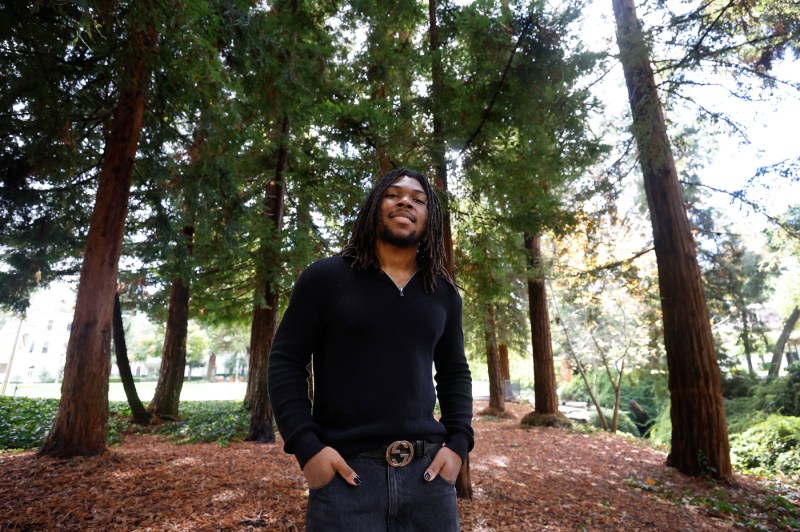
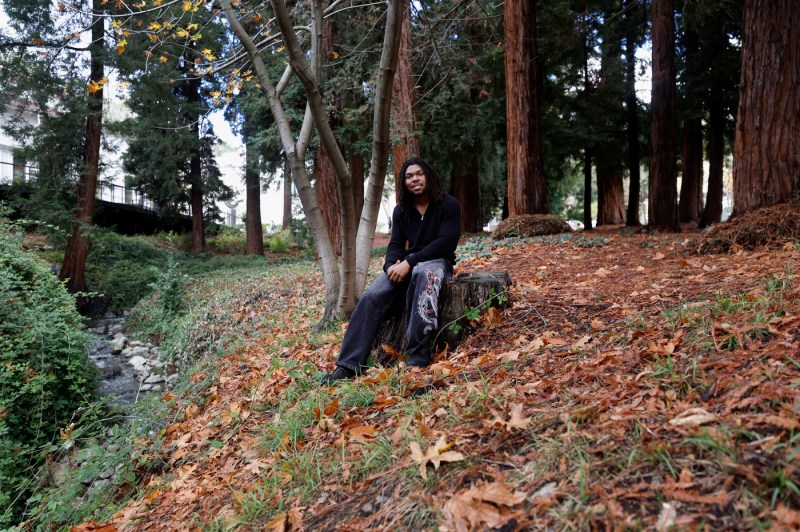
“She said, ‘Wherever you look on this campus, there’s a tree canopy,’” recalls Galloway, a first-year behavioral neuroscience major. Seated on a redwood stump and gazing up to where Lion Creek babbles out of the redwood grove, he sighs. “This is literally perfect.”
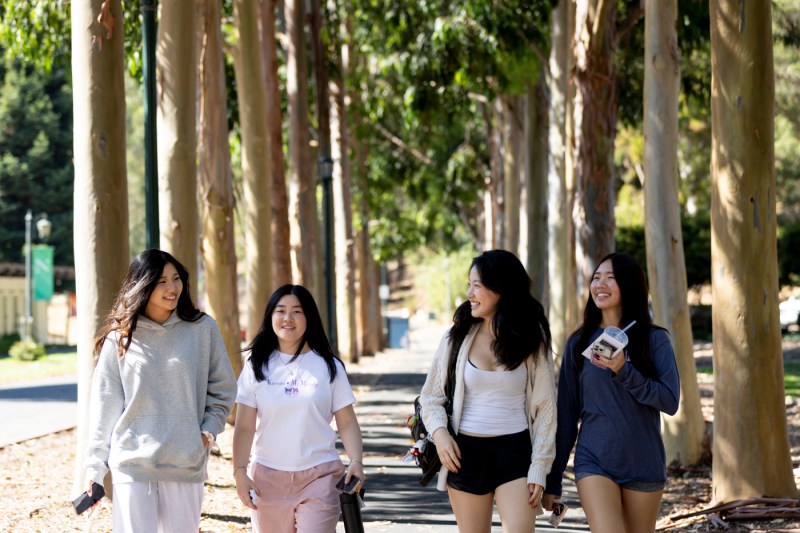
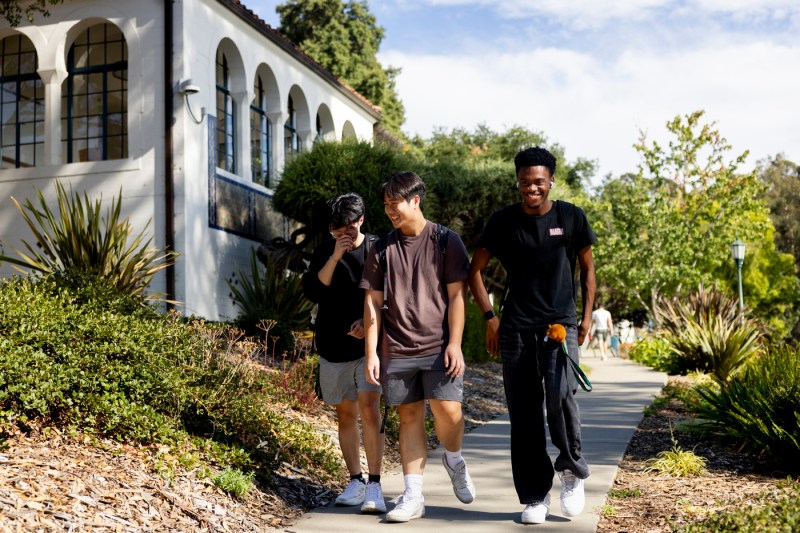
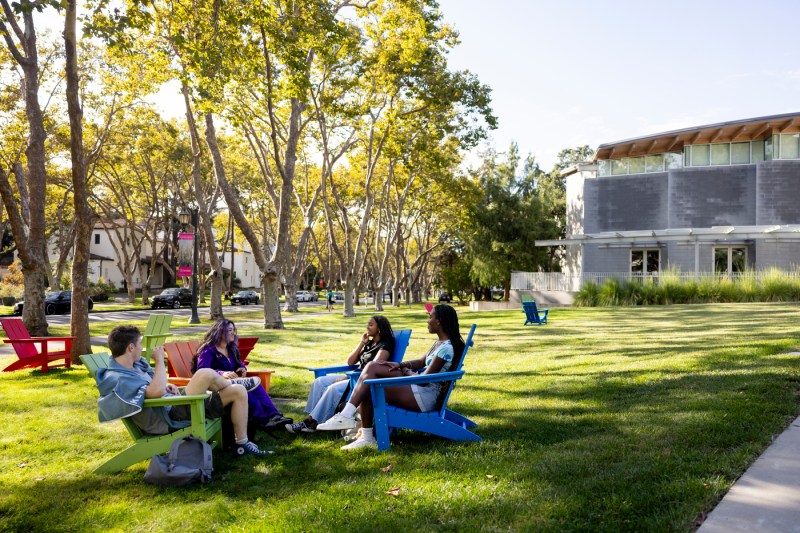
Galloway isn’t exaggerating. From the majestic London plane trees that line Richards Road at the entrance to campus to Tasmanian blue gum eucalyptus that tower over the red-tiled roofs of student housing along Kapiolani Road, more than 5,000 trees thrive on the Oakland campus, representing more than 100 species. For research, teaching and pure enjoyment, the verdant campus adds 135 acres of native and exotic species to Northeastern University’s collective bi-coastal arboretum.
“There’s a lot that we can do right on campus without having to take field trips,” says Sarah Swope, a Northeastern professor of biology and an evolutionary ecologist. “There are native species and there are non-native species. There’s a grassland wildflower area where we can try out different methodologies to collect information about plants. It’s great for plant identification.”
Students in a plant ecology course that Swope teaches collect core samples so they can discuss how trees grow by adding layers of vascular tissue. They can also see evidence of environmental changes the trees have experienced.
“We can map backwards and identify the massive drought in the 1970s followed by the very, very wet period in the 1980s,” she says. “You can actually see that stuff.”
The most abundant trees on campus are the eponymous coastal live oaks that the city is named for. These evergreens have bark like elephant skin and can be shrubby or sprawling, depending on how much space they have. Wherever they grow, shading the Founders Commons dining hall or outside the campus Tea Shop, they leave a litter of slender reddish acorns and convex brown leaves.
Another variety of oak is less common on campus and more of a curiosity. A massive cork oak stands at the base of a steep pathway to Reinhardt residential hall, its thick, wavy bark making the tree look swollen.
This is the type of tree that wine bottle corks come from.
“They almost peel the bark off like an orange,” says Andrew Gonzalez, head of sustainability on the Oakland campus and the go-to expert on its trees. He pulls a knife out of his pocket and carves off a small, porous hunk of bark. “We have about 30 of them in this area.”
On a walking tree tour, Gonzalez points out some of the trees planted by Cyrus Mills, a founder of the college, which opened in Oakland in 1871. Mills was fond of trees from other areas in the world with a Mediterranean climate, Gonzalez says, which features hot summers and mild winters.
Outside the four-story Victorian Mills Hall, a monkey-puzzle tree grows taller than the building. Native to southern Chile, its leaves are sharp and cover most of the tree.
On the other side of Mills Hall stands a mature bunya-bunya tree. Native to Australia, these trees produce a female cone as big as a rugby ball and weighing more than 20 pounds.
“When we see that the tree is developing one, we cordon the area off,” says Gonzalez.
As part of an arboretum, these trees are specimens in a collection and must be accounted for like objects in a museum. This process is called “accessioning,” and involves counting and labeling every tree with a diameter of at least 4 inches for coastal live oaks and 8 inches for other species. Each tree gets its own bronze tag that looks like a credit card and includes the species name, common name and a unique identification number.
“Think of it as the plant’s Social Security number,” says Stephen Schneider, director of horticulture and grounds on the Boston campus. Once complete, all this information will be stored in a database that will become available to researchers around the world.
Editor’s Picks


There is already research underway. Modular weather sensors collect data about particulate matter in the air on the farm of the Oakland campus and on top of the F.W. Olin library, both of which are surrounded by trees. A third will soon be installed at the southern edge of campus near a freeway.
The abundant trees on campus offer an opportunity to compare air quality in different settings, says Carlos Sandoval Olascoaga, an assistant professor of human-computer interaction and inclusive design at Northeastern.
He has placed sensors on the Oakland and Boston campuses, as well as on urban farms in New York City. The sensors send continuous data that will be used to study how built environments affect health.
“One of the interesting features of the sensors in Oakland is that they are located on a farm,” he says. “We can compare the farm environment in Oakland versus the farms in New York City to find the local variations.”
The arboretum, says one city tree expert, is “an oasis” that offers benefits well beyond the campus.
“Green spaces like the Northeastern Oakland campus have a big health impact on the surrounding neighborhoods that have far fewer trees,” says Gordon Matassa, arboricultural inspector with the city of Oakland. “This is especially important in an area like East Oakland, which has significantly fewer trees than other areas of the city.”
For Ash Hariharan, a combined computer science and behavioral neuroscience major, the local impact is calming. For her and her friends, a grove of Himalayan cedar across from the student union is a favorite spot to sit and study. These are actually a type of pines known for the rose-shaped cones they drop in the fall.
“My friend and I designated this as our ‘spot’ pretty early in the year,” says Hariharan, 18. “There’s something very relaxing about hanging out and getting work done when the weather is nice and the grass is dappled by the sun through the tree leaves.”
When Tony Galloway needs a break, he heads to the redwood grove between Lisser Hall and the green basin of Holmgren Meadow. Nestled along the creek’s edge are sword fern plants so bright green they almost glow.
“That spider right there,” he points to two fern fronds, “I watched it build that web.”