World-renowned radar expert Yonina Eldar appointed Joseph E. Aoun Professor
Yonina Eldar has spent the better part of two decades thinking about ways of integrating physics and signal processing to better human life.

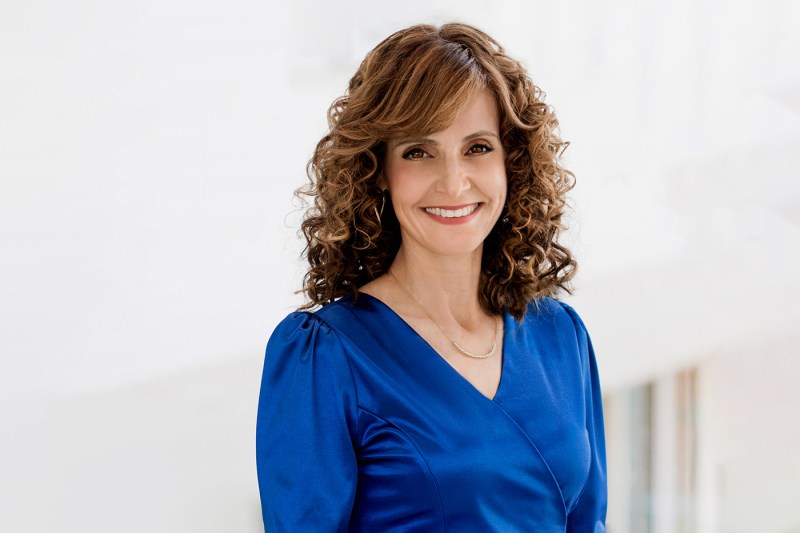
Yonina Eldar has spent the better part of two decades thinking about ways of integrating physics and signal processing to better human life.
Her work has focused on designing systems that capture data and developing engineering solutions that could transform health care, biomedical technology and medical devices. One innovation from her lab is a device called the Bio-Radar Health Monitoring System, which can track patients’ vital signs remotely and noninvasively.
“To me, the human aspect is very important,” Eldar tells Northeastern Global News. “At the end of the day, I’m an engineer, and I get excited over equations and problems we can solve.”
Eldar, who joined Northeastern University this fall, is a pioneer in the field of signal processing, with a deep background in electrical engineering, applied physics and radar applications.
Adding to a long list of accolades, she recently received the 2025 Israel Prize in Engineering, an honor bestowed on individuals who have made exceptional contributions to the advancement of science, technology and national innovation.
Now, she’s bringing her breadth of experience to Northeastern’s College of Engineering as one of the Joseph E. Aoun Chairs. Eight professorships pledged in honor of Aoun have been made possible by a $25 million gift from Alan McKim, vice chair of the university’s Board of Trustees.
Tina Eliassi-Rad was installed as the inaugural Joseph E. Aoun Professor in September 2023. Eliassi-Rad is a professor in the Khoury College of Computer Sciences and holds core faculty appointments in the university’s Network Science and Experiential AI institutes. Lorenzo Torresani, a professor in the Khoury College of Computer Sciences, was also recently named a Joseph E. Aoun Chair.
For Eldar, the opportunity allows her to continue bridging fundamental science with real-world applications, advancing both ends of the research spectrum in an end-to-end fashion.
“I’m really excited by the science, by the engineering, by the interdisciplinary nature of it,” Eldar says. “That means really looking at, on a system level, how we go from the basic physics, to building sensors, to applying the data — and, again, using the physics and engineering — to develop effective algorithms.”
Editor’s Picks





Asked what drew her to Northeastern University, Eldar says the university’s interdisciplinary nature and propensity to address “big problems.”
“There’s so many people doing so many different things,” she says, “and it’s really rare to see such a big environment where people really do collaborate from different disciplines.”
“To me,” she continues, “I wanted to work at an institution that encourages working on larger problems with broad human impact. And Northeastern is really unique in that way in that it’s a huge network, and there is so much excellent faculty who really do work together.”
“We are very lucky to have attracted a world-renowned scholar of professor Eldar’s pedigree to our faculty in the College of Engineering,” says Gregory D. Abowd, dean of Northeastern’s College of Engineering. “Her expertise in radar technologies, signal processing, AI and health will amplify our strengths in those areas and take us to new heights.”
Eldar spent 17 years at the Israel Institute of Technology, or the Technion, where she established and led the groundbreaking SAMPL Lab. The lab focused on developing technologies that streamline how signals are harnessed and applied across a wide spectrum of systems — from computers, cellphones and autonomous vehicles to medical devices and defense applications.
In 2019, she moved from the Technion to the Weizmann Institute of Science, where she founded and ran the Biomedical Engineering and Signal Processing Center, with sabbaticals at the Massachusetts Institute of Technology and Stanford University. Her professional and academic honors include over 400 journal articles, more than 20 registered patents, and more than 45 awards from various organizations and academic institutions.
Beyond her research, Eldar says she enjoys mentoring students in the lab.
“It’s not necessarily just about the research; it’s also about giving them [the students] tools, confidence, creativity and a desire to really push themselves in using their talents to improve human lives and the world,” Eldar says. “The educational part of it was always very important — and the inclusiveness. A lab is a place where you can have people from very different backgrounds, from different cultures, abilities and political views — and they can all work together.”


