How this entrepreneur built an e-commerce network for Latin America
Kangu uses more than 5,000 mom-and-pop businesses as pick-up and delivery locations for products sold on Mercado Livre.

Getting an MBA at Northeastern provided the operational maxim for Ricardo Araujo’s successful Latin American e-commerce network: the more diverse and eclectic the team, the stronger it becomes.
“One of the most powerful experiences I had was learning to truly recognize and value others’ perspectives, especially those of international students with very different backgrounds,” Araujo said recently in a video call from his home office in São Paulo. “That became a guiding principle for me.”
Araujo received his MBA in 2002 with a focus on finance but he has made a career in logistics, helping to lead one of Brazil’s largest transportation companies and going on to build an innovative distributed shipping system with more than 5,000 pick-up and delivery locations in Latin America.
His core value: To combine his own experience with people who don’t think the same way he does.
“I thought that I knew something,” Araujo said, recalling his arrival in Boston. “But when you get people from Kenya, from India, from Russia, from the U.S., from France — all in the same room for a long time — you realize that you just know a little bit,” he added, gesturing with his finger and thumb, held close together.
After finishing his degree at Northeastern in 2002, he returned to Brazil to work for the Brazilian logistics company Rapidão Cometa, where he had earlier been employed in his hometown of Recife on the country’s northern coast. This time, however, his role was as the São Paulo manager, responsible for 500 employees. He was just 27 years old.
“I thought the owner of the company was crazy to give this job to a young guy,” Araujo said. “But we open a lot of branches. We grew a lot.”
Then in 2012 the company was acquired by FedEx. Araujo became general director. He was working every day. His health suffered, he said, and after 10 years he left.
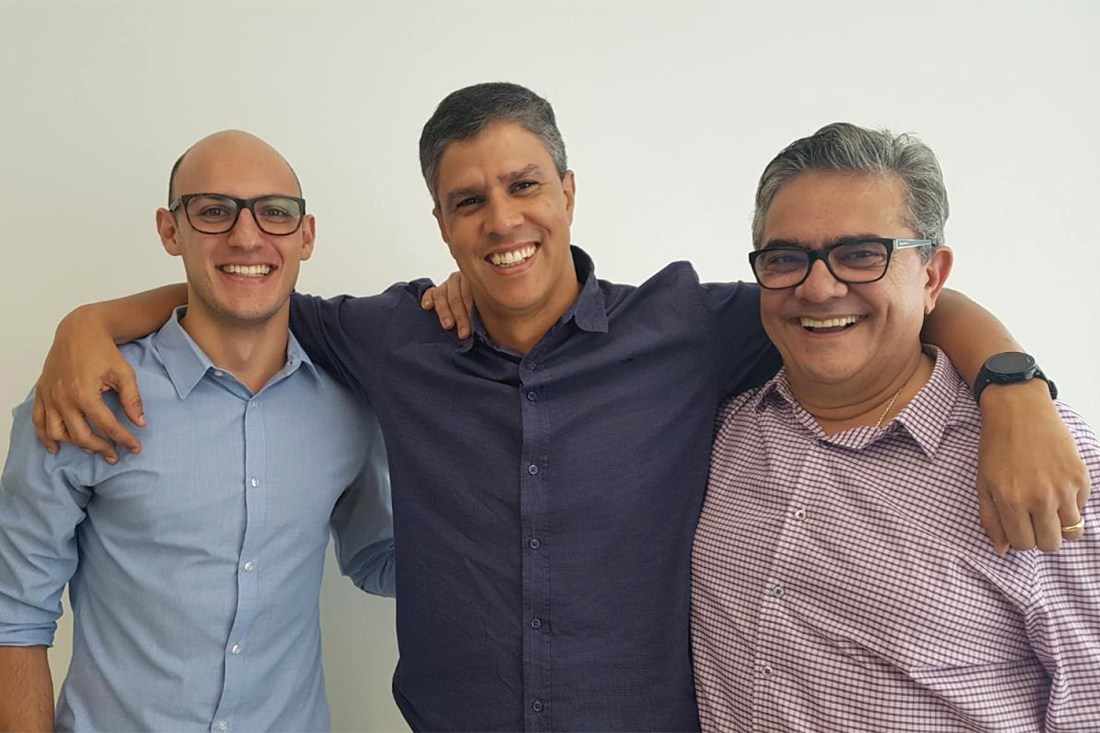
This is where his experience at Northeastern really paid off, he said. In 2017, Araujo started a consulting company with two close colleagues from Rapidão Cometa.
The three men couldn’t have been more different from one another, Araujo said, but they knew how to make it work.
Together they researched and brainstormed a new e-commerce logistics model that makes better use of time for drivers, sellers and customers. They focused on transactions made through Mercado Livre, the Latin American e-commerce platform. Their idea was to make transactions and deliveries easier by setting up product pick-up and drop-off points in preexisting small businesses.


In Brazil, a product can’t be left at a residence if the delivery person comes when no one is home, Araujo explained. This created a logistics bottleneck. Their new business, named Kangu, created a network of businesses consisting of local merchants, where goods could be delivered.
They avoided changing the main purpose of the stores, not turning them into warehouses. For example, if it was a pet shop, it remained a pet shop, Araujo said, stressing the importance of maintaining a neighborhood’s particular environment.
During the COVID pandemic, Araujo’s Northeastern experience kicked in again. He recalled how on Sept. 11, 2001, he was doing a co-op at the New Jersey headquarters of candy company Mars Wrigley when terrorists hijacked commercial airliners and flew them into the World Trade Center.
“It was a unique and emotional time,” he said, “but what struck me most was a decision made by the company’s president.”
His focus shifted from immediate financial ramifications of the event to providing support for employees affected by the attacks.
“Witnessing that made a lasting impression on me,” Araujo said, and he followed that example when leading his Kangu staff through the pandemic.
“That lesson became vital,” he said. “Rather than making decisions based only on financial logic, we relied on our core purpose and values.”
They made no layoffs, and when the economy in Brazil began to recover, the company’s network of drivers was intact “and more committed than ever, ” he said.
E-commerce business flourished, and three years after starting the company, Araujo and his partners sold Kangu to Mercado Livre.
Now, with time to reflect on his next career move, Araujo said he finds himself thinking back to his job as a teaching assistant at Northeastern, working with professor of accounting Ganesh Krishnamoorthy. Teaching undergraduates pushed him to think with empathy and creativity, he said.
“That ability to connect and inspire people has stayed with me throughout my professional journey,” he added.


