Why Smucker’s is taking Trader Joe’s to court over PB&Js
The food company is claiming the grocery chain copied their Uncrustables in a lawsuit filed in Ohio.

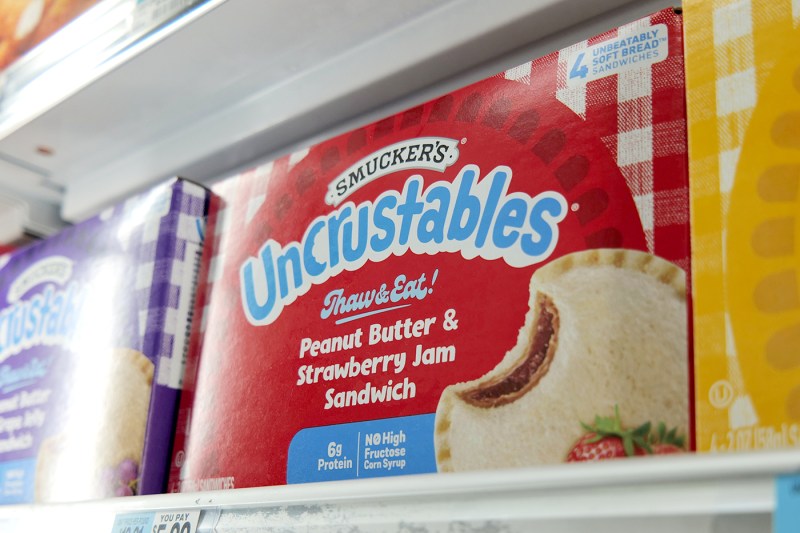
The concept of a peanut butter and jelly sandwich is not new. Neither is the concept of a circular, crustless PB & J.
But Smucker’s, an Ohio-based food company, is claiming its Uncrustables sandwiches, which come with different jam fillings and peanut butter sealed in a round, crustless bread pocket, are original, and grocery chain Trader Joe’s copied the concept with its own sandwiches.
Smucker’s recently filed a lawsuit over this, claiming trademark violation. But Northeastern University experts expressed skepticism and say the suit is unlikely to succeed. The experts argue that Smucker’s can protect the Uncrustables name, but not the functional design — such as the round shape or crimped edges — which serves a practical purpose. In addition, Trader Joe’s private-label model makes consumer confusion improbable.
“My initial thought was that Smucker’s is trying to strike out where they can because they don’t have the degree of protection that they would like,” says Chad O’Connor, a marketing lecturer and brand-building expert at Northeastern University. “Their product is popular and they can claim ownership of the name ‘Uncrustables,’ but they do not have ownership over the concept of a crustless peanut butter and jelly sandwich, and they certainly don’t have domain over the idea of crimping something to keep it closed.”
Alexandra Roberts, a professor of law and media at Northeastern and intellectual property expert, echoes this sentiment, adding that the law makes it so companies cannot trademark functional designs in order to put competition at a disadvantage. This would include something like the shape of a sandwich or the crimping around the edges (which O’Connor pointed out is found on products like ravioli).
“A design is unprotectable if it’s useful,” Roberts says. “If a design is essential to the use of the item or affects the cost or quality, you cannot give exclusive rights to one party to use that design. In the market of easy-to-eat sandwiches, it’s fair to say a circle is a useful shape. Closing the edges in this way serves a purpose.”
What trademark laws generally protect, Roberts says, is source indicators of the brand. Smucker’s lawsuit also claims Trader Joe’s copied its use of a crustless sandwich with a bite taken out of it, which Roberts said likely wouldn’t fall under the protection of the law.
“If you make a peanut butter and jelly sandwich sealed around the edges and then you market it with a photo of that sandwich with a bite taken out of it, that makes sense to show people what’s inside,” Roberts says. “It’s really standard (and functional). Smucker’s might have protection for one specific image of a sandwich with a bite missing, but they don’t have protection for all iterations of that (image).”
Similarly, the lawsuit’s claim that Trader Joe’s use of blue packaging on its product is copying Smucker’s also won’t likely hold, Roberts says, as the overall packaging between the two is so different.
However, there are blatant similarities between the products, says Kate Karniouchina, associate professor of marketing at Northeastern University, who has performed litigation support work on trademark infringements.
“It’s hard to say there’s no infringement on the look and feel,” she adds.
Editor’s Picks




In order to have a strong case, Roberts says Smucker’s needs to show valid trademarks to assert and a likelihood of consumer confusion between the products. But Northeastern marketing experts say the latter is unlikely given the Trader Joe’s brand.
Trader Joe’s sells mostly its own branded items, which are called private labels, says associate dean of marketing research Koen Pauwels, who has researched private labels. Private labels are common in European retailers, as well as in certain ones in the United States. (For example, Target sells private-label products.)
Private labels allow retailers to make more money, even though their goods are often made in the same facilities as other labeled items, Pauwels adds. It’s uncommon to see brands sue retailers over private labels because many don’t want to risk the loss of a certain chain carrying their product. This makes the Smucker’s lawsuit unique, but also means its claim might not carry much merit.
Part of Trader Joe’s business is that it mostly carries private-label products. This means most people go to Trader Joe’s not expecting national brands.
“Trader Joe’s is very popular,” Pauwels says. “People go there and they’re mostly confronted with private labels. That’s how the business model works.”
This would make it difficult to prove damages as customers are not opting for one product over the other, because they’re not being sold side-by-side, so it’s hard to argue they’re losing shelf space to Trader Joe’s, says Karniouchina.
“I don’t think people who go to Trader Joe’s are looking for national brands,” she adds. “They’re in no way confused about the product.”
Ultimately, O’Connor says the lawsuit might be a way to prove Smucker’s was the original when it comes to this product, even if it’s not ultimately successful.
“The best case is probably drilling home a theme and messaging for customers, that, like they’re the original and a brand name that’s been around for a very long time,” O’Connor says. “A lot of people grew up having Smucker’s jelly on their peanut butter and jelly sandwiches, and there is something of a nostalgia element, or a time tested element to the brand, and if there are all these knockoff products out there, the fact that they are the original (will make) a lot more people want to go with the safe choice of what they know.”