Want to eradicate malaria-bearing mosquitoes? Try fungus, this researcher says
A Northeastern postdoc has created a mathematical model that demonstrates how a fungal solution could control malarial mosquito populations.

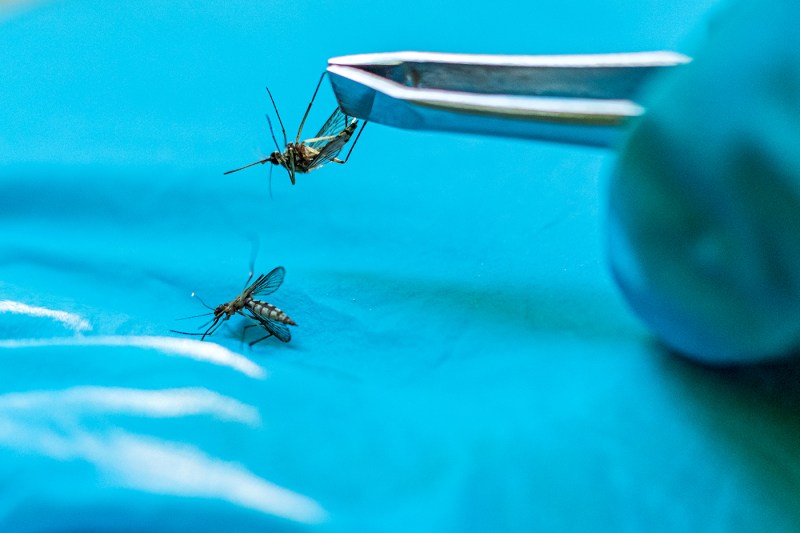
A fungal infection solution could help eliminate up to 86% of malaria-carrying mosquitoes, offering a powerful new tool in the global fight against the disease, according to new research.
Binod Pant, a mathematician and postdoctoral researcher at Northeastern University’s Network Science Institute, led the new interdisciplinary and intercollegiate research.
This is the first time that this fungus, called Met-Hybrid, has been mathematically modeled to demonstrate its effectiveness, Pant says.
Pant says that he joined the project almost entirely by accident. While attending a conference, he met an entomologist who proposed using a fungus — toxic only to mosquitoes — that could dramatically reduce the mosquito population in Burkina Faso, where their research was conducted.
“I quickly figured out a mathematical model that we could use to try to explain this to public health people,” Pant says.

In practice, this would entail the researchers releasing many male mosquitoes — about 10 fungus-infected male mosquitoes for every wild mosquito — every three days for six months.
Understandably, when the public hears proposals like this, they get a little nervous, Pant notes. That’s a lot of mosquitoes to release into the wild.
But, crucially, it’s only female mosquitoes that bite humans, and so releasing male mosquitoes wouldn’t increase the chance that some of them could contract malaria, or another disease, and spread it to humans.
Malaria remains endemic across much of the African continent. The World Health Organization (WHO) reports that, in 2023, “there were an estimated 263 million cases and 597,000 malaria deaths worldwide.” Ninety-five percent of those deaths occurred in Africa.
How to control the mosquito population — the primary disease vector for malaria, along with other deadly diseases like dengue, yellow fever, West Nile virus and others — is a topic of great concern, and the WHO hopes to eliminate 90% of malaria cases and mortalities by 2030.
treated male mosquitoes
to wild mosquitoes
86%
reduction in female
mosquito population
treated male mosquitoes
to wild mosquitoes
90%
reduction in female
mosquito population
Pant’s math shows how the numbers would play out: An 86% decrease of the mosquito population in Burkina Faso, with the fungal method. To hit the WHO’s target of 90% would require a much higher rate of release, six infected mosquitoes for every wild one, released every day for five months.
Of fungi and genetic modifications
Editor's Picks


Other researchers have proposed various methods to help eradicate malaria, including genetically altering male mosquitoes, releasing them into the wild and allowing them to breed with wild female mosquitoes.
While Pant’s research shows that the genetic approach could achieve a comparable success rate, he also says that this is an imperfect solution. There has been “some regulatory pushback, maybe an ethical pushback” toward genetically modifying mosquitoes, he says.
Conversely, he continues, “here, we’re not touching the mosquito — our collaborators are genetically modifying a naturally occurring fungus to make it more lethal toward mosquitoes.”
Pant also notes that the fungus isn’t harmful to other animals, including other insects or predators that prey on mosquitoes. When the fungal-infected mosquitoes are consumed (alive or otherwise), that other animal is unaffected.
“Mosquitoes are part of food webs, but no species relies exclusively on them,” according to Pant. Moreover, in his research, they are “targeting a very specific subset — the Anopheles species that transmits malaria — not eliminating all mosquitoes. Localized reduction of disease vectors is unlikely to cause ecosystem disruption.”
The fungal approach “is more environmentally friendly, and we're hoping that this also doesn't have as much of a pushback from an ethics point of view,” Pant says.
Mathematical models for real-world problems
Pant was excited to apply his modeling skills to a very real problem, and the research has quickly gained momentum. “This was actually meant to be one of my fun projects, but it has now, at this point, turned into one of the major research directions, which I’m hoping to take further,” he says.
There have been numerous attempts to combat malarial mosquitoes in the past, but the little bloodsuckers have developed resistance to many of these attempts, Pant says. For instance, certain mosquitoes have evolved tolerances to chemically coated bed nets, and the genus of mosquito that carries malaria has a “well-documented resistance” to chemical insecticides, according to Pant’s co-authored paper.
Meanwhile, there has been little to no “observed resistance to pathogenic fungi in insects,” according to the paper, and other laboratory research in Burkina Faso shows that the local malarial mosquitoes also do not develop a resistance to Met-Hybrid.
The research involved collaborators from the Institut de Recherche en Sciences de la Santé and the Institut National de Santé Publique in Burkina Faso, the University of Karachi, University of Maryland and University of Pretoria.
Pant hopes that the fungal solution will become part of a holistic strategy to protect the population of Burkina Faso, and potentially other countries in the future. He sees a “synergy between these more traditional approaches,” like the bed nets, alongside the fungus.
But Pant’s primary intervention is in a policy direction. “We're trying to help the regulators understand this from a mathematical point of view,” he says. “Now, with simulations in hand, hopefully this helps convince the local stakeholders that this method could work at scale in wild mosquito populations.”


