Podcast gold: Aoun on how universities can leverage the AI era
“You cannot retrench. No one can retrench, even in periods of disruption,” said Northeastern University President Joseph E. Aoun.


Higher education is headed for three icebergs, but Northeastern University President Joseph E. Aoun says there are several ways educational leaders can prepare for those challenges.
Fewer people are going to go to college, public trust in universities is fraying, and artificial intelligence is upending the way educators teach and students learn.
The industry must adapt, Aoun said on the most recent episode of the D’Amore-McKim School of Business’ International Business Today podcast.
“It is more important now than ever to reaffirm as a community, as an institution, your values, your mission and have a strategic plan that is forward-looking,” Aoun said in a conversation with Paula Caligiuri, a Northeastern University distinguished professor of international business and a host of the podcast.

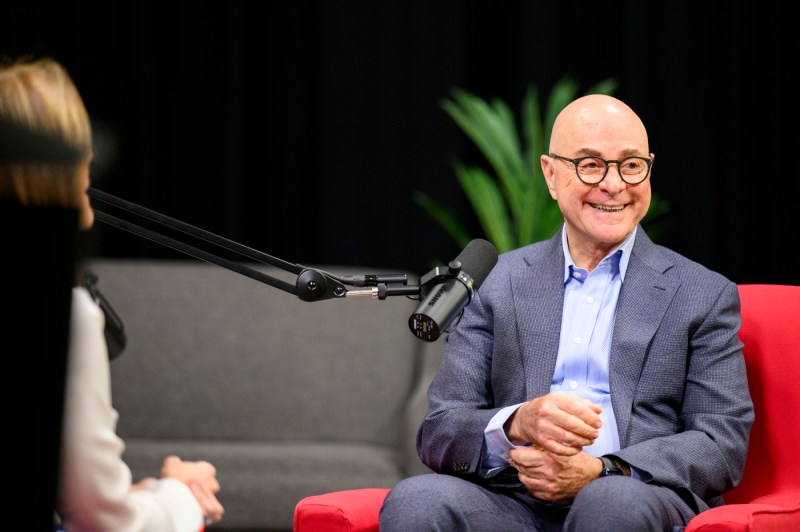


Since 2023, Caligiuri and fellow international business professor Ravi Sarathy have co-hosted the podcast. Over that time, the two have interviewed a growing list of Northeastern faculty, researchers, entrepreneurs, CEOs, policymakers and more.
“It all began really because we were trying to get all the great research out of D’Amore McKim out in the public,” Caligiuri told Northeastern Global News. “Since then, we’ve been interviewing faculty all over the university, many from different parts of the business school.”
The co-hosts have also interviewed world-class thought leaders and innovators outside of Northeastern, including most recently Dr. Philip Sharp, Nobel Prize laureate and biotech innovator.
They don’t pull their punches — employing an interview style that is equal parts conversational and hard-hitting while speaking with guests in Northeastern University Experiential Digital Global Education’s (EDGE) well-lit and homey studio in Boston.
During a recent illuminating 41-minute conversation, Caligiuri and Aoun went deep on the challenges facing higher education and the important contributions Northeastern University is making to address them.



“You cannot retrench. No one can retrench, even in periods of disruption,” Aoun said.
One of the biggest disruptions facing higher education that Aoun highlighted is a decline in college enrollment, driven in part by an aging population and a decrease in students pursuing higher education after high school, he said.
This is also in part due to a growing skepticism of higher education as a whole, he said, adding that universities can certainly combat negative narratives. One way to do that is for higher education to better explain that ideological bias is not representative of universities across the board.
At the same time, universities need to highlight how their research “is changing lives and allowing society and the nation to continue to thrive,” he said.
But how do you get the word out, asked Caligiuri. Should people be doing more podcasts?
Editor’s Picks




“We obviously have to help people realize what is being done, and this podcast is an example,” Aoun said.
But graduates should also play a critical role, he said.
“Every university has thousands of alumni,” he said. “Those alumni should be the ambassadors of the place. … explaining to society what is happening in the university. Beyond that, they are proof of the impact of education.”
Equally, universities have an immense opportunity with the advent of artificial intelligence, he said, emphasizing that there is a need“ to integrate AI into our thinking, in our learning and in our research.”
“That means our core curriculum has to change. Our research approach has to change,” Aoun added.
“How do we go about doing that,” asked Caligiuri.
Over the past decade, Northeastern has made it a priority to teach students to have AI literacy, data literacy and human literacy as part of a broader educational framework Aoun pioneered called humanics.
“We want our students to have the three literacies, but beyond that the real opportunity for us is to help society and help our students understand the balance between agentic AI and human agency,” he said. “That’s the thrust of everything we do.”
Humans excel at understanding context and applying concepts learned in one domain to another. Machines not so much, Aoun said, which makes Northeastern’s focus on experiential learning perfectly aligned for this moment.
He explained that “when you are sending a student to a co-op for six months, or four months, or five months it doesn’t matter. They are really embedded in a workplace, whether it’s for-profit or not-for-profit. What are they doing? They are understanding what they are good at. They are practicing teamwork. They are practicing cultural agility.”
That being said, “AI is pushing our boundaries” and increasingly “making us obsolete,” Aoun stressed.
That’s why it’s important to understand and use the technology and continue to be lifelong learners, he said.
“We all need to reskill ourselves, upskill ourselves, or reinvent ourselves,” he said.