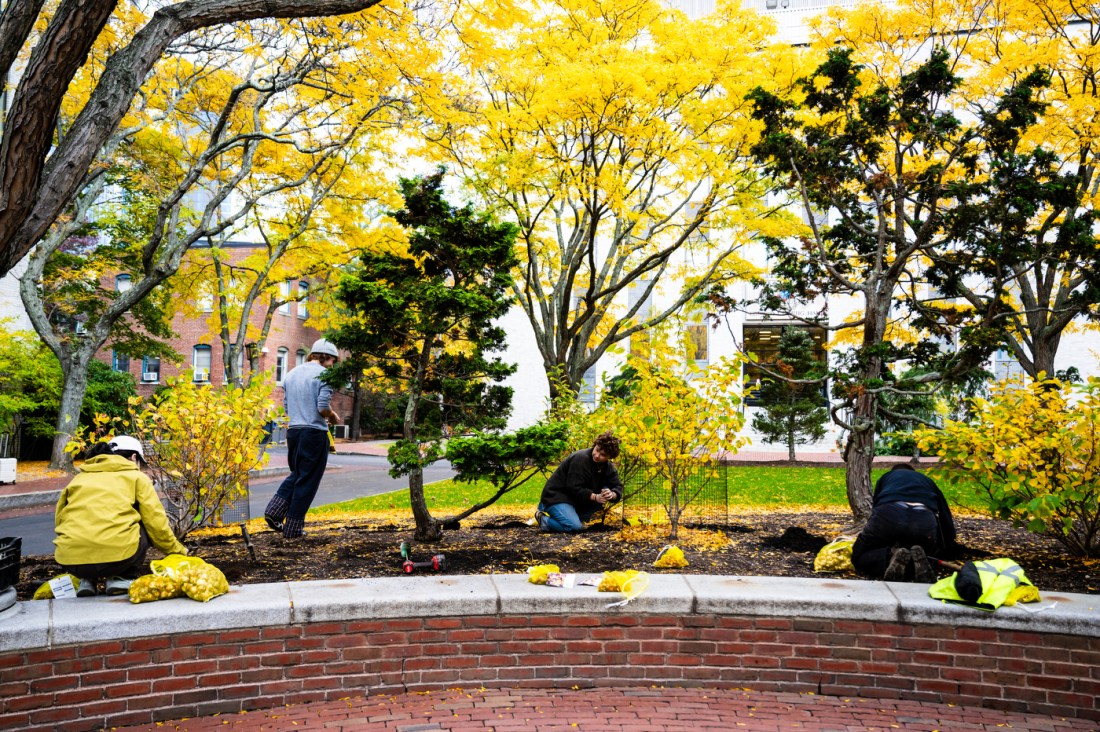
Spring in November? Student volunteers and arboretum staff plant thousands of tulips on Boston campus
If the New England winter cooperates, a riot of fire-colored tulips, white snowdrops and yellow daffodils will bloom just in time for Northeastern’s commencement season in late spring.

If the New England winter cooperates, a riot of tulips, snowdrops and daffodils will bloom just in time for Northeastern’s commencement season. Video by Glenn Pike / Northeastern University
If you took a stroll around the Curry Student Center on a recent Monday morning in November, you probably spotted stacks of flat crates filled to the brim with what looked like small onions. Instead of the dining hall, however, these were headed into the ground.
In late fall, the horticulture staff in Northeastern’s Planning, Real Estate and Facilities department (PREF) begins preparing for spring. On this particular morning, that meant planting thousands of tulip bulbs around the university’s campus arboretum — a task that, with cooperative winter weather and a little bit of luck, will result in a riot of campus color just in time for commencement ceremonies by late April.
“We’ll plant maybe 3,000 today,” said Brendan Joseph, a Northeastern horticulturalist. He and his arboretum colleagues, horticulturist Kelly Young and plant recorder Indira Holdsworth, started by giving instructions to a group of student volunteers gathered on Richards Quad.
“The extra hands and effort are a lot of help for our department,” Young told the group.
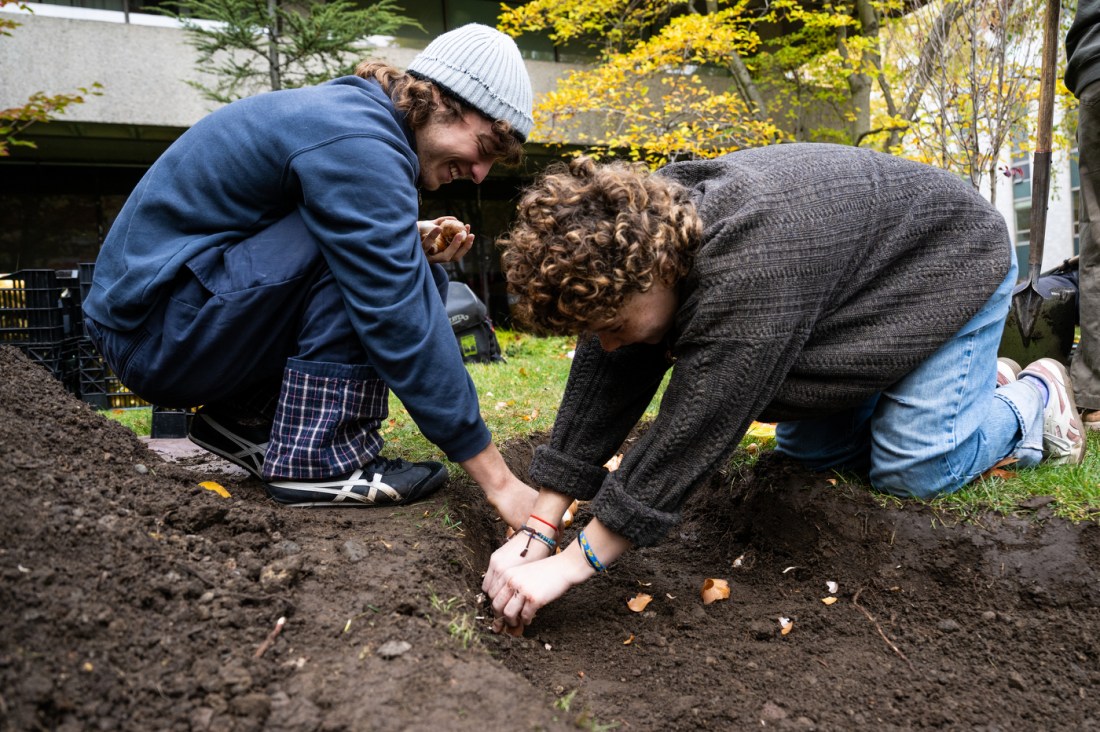
She explained that the morning would involve two types of cultivation. First, in the flowerbeds around Richards and nearby walking paths, would be “naturalized” planting, or placing perennial, native species of flowers in spots where they could take root and come back each spring.
“The perennial tulip species spread naturally, and they perform better year after year,” she said. “You don’t have to dig them up and replant.”
By combining the tulips with snowdrops (the small white flowers that pop up first in the spring), daffodils and purple camassia, the goal was a “meadow look.”
“Picture the different colors popping up together,” Young advised. “You really have free range to do whatever you want.”


Over the years, Northeastern’s approach to landscaping has evolved toward this type of naturalized growth, says Joseph, who joined the horticultural staff in 2012. In many areas, native, self-sufficient plants and trees have slowly replaced turf, which is harder to maintain. In 2019, the Boston campus was officially recognized as a level 2 arboretum.
“Our goal is to create an urban forest,” Joseph said. “It’s just more sustainable. You’re not using as much; you’re not throwing away as much.”
But there is still room for a few gardening showpieces, and the morning’s second project was more intentional: a burst of fire-colored tulips, imported from Holland, planted together in two clumps to form a yin-yang symbol in the middle of the koi pond sculpture park. A staple of graduation season, the design includes a space between the two sides so graduates and loved ones can pose for photos inside.
“They’re a vibrant mix of colors,” Joseph said, describing the heady combination of pinkish orange, red and yellow tulips in the arrangement. The varietal in the design is known as “El Niño,” after the meteorological phenomenon and its characteristic warm temperatures.
Outfitted with shovels and gardening gloves, volunteers dug down 2 inches in depth (enough to fully cover the plants) and worked quickly; soon, the entire yin-yang was flush with brownish white bulbs.
Editor’s Picks





The students on hand, including Emily Maez, a third-year student who recently switched her major to environmental studies, relished the chance to get outside and do some gardening — not a routine opportunity living on an urban campus.
“I was an architecture major before,” she said, “but I was always more [attracted to] the sustainability part. “I really like design, but I wanted to do something with the earth.”
She spent a month in Costa Rica this past summer on a regenerative farm, doing “a ton” of gardening and learning soil replenishment techniques. The morning’s session wasn’t quite Costa Rica, but it was still an excuse to get in the dirt.
After the bulbs were settled, the staff netted off the planted area to discourage foot traffic, which can pack down the soil and make it difficult for the plants to break through. It was one of several obstacles the flowers would face on their way to a (hopefully) dazzling spring debut.
“The winter is going to affect how fast they come up,” Joseph said. Sooner, warm temperatures will mean earlier blooms; rain is good. “The squirrels will start to try and dig them up, and the rabbits will go after them,” he added.
As anyone with a garden in Massachusetts knows, he’s serious. “The rabbits … they’re relentless,” Joseph sighed.