Who was Jessica Mitford?
New book seeks to unlock her life
The Mitford sisters are having a moment, but a Northeastern professor is finally shining a light on the tour de force that was Jessica Mitford.

Even compared to her famous British aristocratic sisters, Jessica Mitford lived a fascinating life.
As a teen, she ran away from home to fight fascism in the Spanish Civil War. She moved to America with nothing and ended up creating a career for herself as a writer and activist. She was a Communist who refused to testify in front of the Un-American Activities Committee, a singer who once opened for Cyndi Lauper and a writer whose expose on the funeral industry is still in print today.
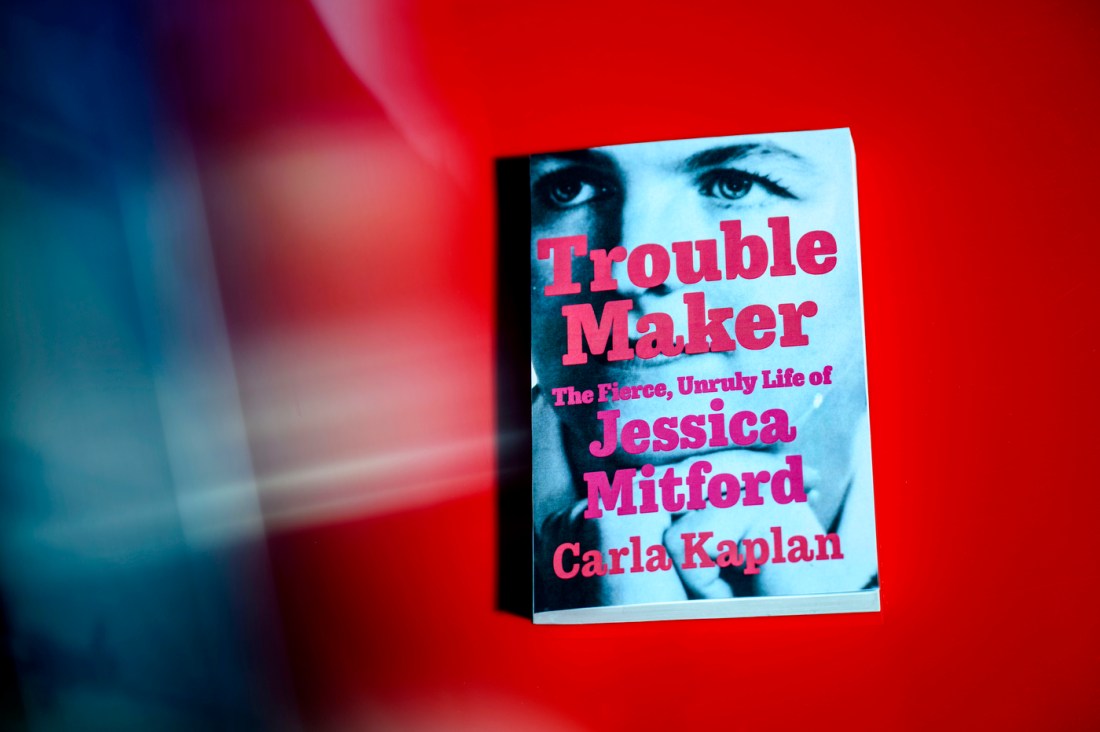
When Mitford died in 1996, she left behind 500 boxes of memorabilia. This served as the foundation for Northeastern University professor Carla Kaplan’s latest book, “Troublemaker: The Fierce, Unruly Life of Jessica Mitford.” Out Nov. 25, it is a notably comprehensive biography of Mitford.
“You would have thought somebody before me would really make a fuss about Jessica Mitford,” says Kaplan, Northeastern’s Davis Distinguished Professor of American Literature. “I think Jessica is far and away the most interesting of (the sisters). She has to completely reinvent herself and she’s so brave. She was not only a brilliant activist. She had an irrepressible sense of humor she applied to everything, including death. Her model of fighting by keeping up her spirits is a great model.”
“Troublemaker” spans Mitford’s life, from her family history to her death. Born in 1917, to right-wing British aristocrats, Mitford was one of six sisters called “The Mitford Girls,” known for their beauty and eccentricity. They have been immortalized in media like the BritBox show “Outrageous.”
While her sisters stayed close to their roots, Jessica Mitford left the comfort of the aristocracy as a teen when she ran away to marry her second cousin and fight against fascism in Spain. She and her husband then went to America, taking up odd jobs like selling silk stockings door to door.

“Even as a very young child, she was motivated by a profound sense of fairness,” Kaplan says. “The British class system made no sense to her. She couldn’t understand why a very few people had so much, and so many people had so very little. The British aristocracy is not raised to look at things that way, and her sisters did not look at things that way. They were not concerned with fairness, and none of them was interested in social justice. It was very difficult for her to be the only one in her family with progressive views.”
Disowned by her family, her husband’s death in World War II left Mitford alone, save for her infant daughter. She rebuilt again, getting a job as an investigator for the Office of Price Administration. Eventually, she moved to Oakland, California, married a left-wing lawyer and became a registered Communist, writer and activist in the civil rights movement.
“She is a phenomenally successful foot soldier,” Kaplan said. “Here she is, this white woman born to the British aristocracy, working on the streets of Oakland to deal with police brutality against Black people. Some people would have suppressed the aristocratic accent and manners. She did the opposite. She knew that she stood out so she used that.”
Editor’s Picks





Mitford’s career as a writer and investigative reporter blossomed in the 1950s. She covered the Freedom Riders and published books examining the funeral industry (“The American Way of Death”), the prison system and American obstetric care, as well as memoirs about her childhood and experience in the Communist Party.
Kaplan says that despite the Mitfords’ growing popularity, there has been relatively little written just on Jessica Mitford, particularly when it comes to full biographies like “Trouble Maker.”
This could, in part, be due to the daunting amount of material to go through in order to capture her. Kaplan says Mitford was “one of the most interviewed women in history.” Among her effects were over 200 recordings of her speaking.
Kaplan also conducted 50 additional interviews with people who knew Mitford. Many of her friends and relatives also gave Kaplan additional material to study. In the end, she ended up with over 600 boxes of material to comb through, while the finished product contains almost 3,000 footnotes.
“The research for this book was far and away the most voluminous I have ever done,” says Kaplan, who has written seven other books. “The archival research was absolutely extraordinary. To do really deeply researched trade books (like this) is not that common.”
On Dec. 1, Kaplan will talk about the book at Harvard Book Store with Northeastern’s Margaret Burnham, a university distinguished professor of law who directed the Center for Law, Equity and Race and the Civil Rights and Restorative Justice Project.