Disinformation and distrust means we know very little about how supply chains are being affected by war in Ukraine
“All we know is we don’t know much, to be honest,” says Sara Rye, who co-authored a paper with colleague Dilshad Sarwar. “We know that there is a huge gap in the data.”

LONDON — The disruptive effects of Russia’s invasion of Ukraine are laid bare in a Northeastern University paper summarizing the war’s effects on the global supply chain.
Dilshad Sarwar and Sara Rye, researchers at Northeastern’s London campus, conducted a systematic review looking at the known facts and analysis, taken from 22 scholastic papers, about the war’s supply chain knock-on effect.
Their compendium, published in Frontiers in a paper, “The impact of the Russia-Ukraine war on global supply chains: a systematic literature review,” is a fresh confrontation with the dire situation Ukrainians are living through.
In a country once known as the bread basket of Europe, the conflict’s disruption to grain exports wiped $859 million off the value of Ukraine’s economy, and the ports — such as Odessa and Mariupol — where 70% of Kyiv’s exports previously departed from, have been either blockaded, targeted or captured by Moscow’s forces.
Sarwar and Rye note that studies have shown that industries that relocate due to armed struggles can take almost a decade to return after the conflict’s resolution. That end to hostilities does not appear to be near after the United States canceled a meeting with Russian President Vladimir Putin on talks to end the war.
The impact of the war has not been isolated either. The incursion pushed natural gas prices up in Europe by as much as 130% in its first six months, while Russia’s sanction-hit economy declined by 2.1% in terms of GDP in 2022 and again by 0.2% in 2023.
The purpose of the review may have been to set out the facts but it was also to find out where the gaps in the data and the research lie, the researchers say.
Rye, an associate professor in project management, says the review made something abundantly clear — that even with a conflict that has been raging for more than three years, the true situation about the supply chain impact is still not properly understood.
“All we know is we don’t know much, to be honest,” she says. “We know that there is a huge gap in the data.”
There are two main reasons for that, argues Rye: Russian disinformation and reluctance among Ukrainian officials to be candid.
“The problem in war, and especially in this particular war, is that there’s not enough data coming out,” continues Rye, who has a background in researching humanitarian supply chains during crises.
“You don’t know how trustable it is or not because the Russian counterintelligence is too strong. They get a lot of misinformation out so you don’t know what data is true — and that’s a problem.”
With Ukrainian authorities, Rye says they “don’t want to paint a bad picture of the country” as the leadership looks to maintain morale. “They are not going to give an update and say, ‘Our supply chain is fragile’ and let you publish that.”
Editor’s Picks





The “next challenge,” as Rye puts it, is to find those with the primary data who might be able to paint a picture of how the conflict continues to disrupt livelihoods and economies.
And she already has an idea where that data could come from. There are about 5.7 million refugees who have been forced to leave Ukraine since the fighting began in February 2022, according to the United Nations High Commissioner for Refugees.
Some of those displaced people could hold the key to gaining more insight, Rye suggests. “If you get to the refugees,” she says, “then maybe that data can be used for more qualitative data interview surveys, and then you can analyze that data.” The Northeastern researchers are keen to speak to those who may have primary data or be able to provide insight in order to advance the understanding of the war’s supply chain impact.
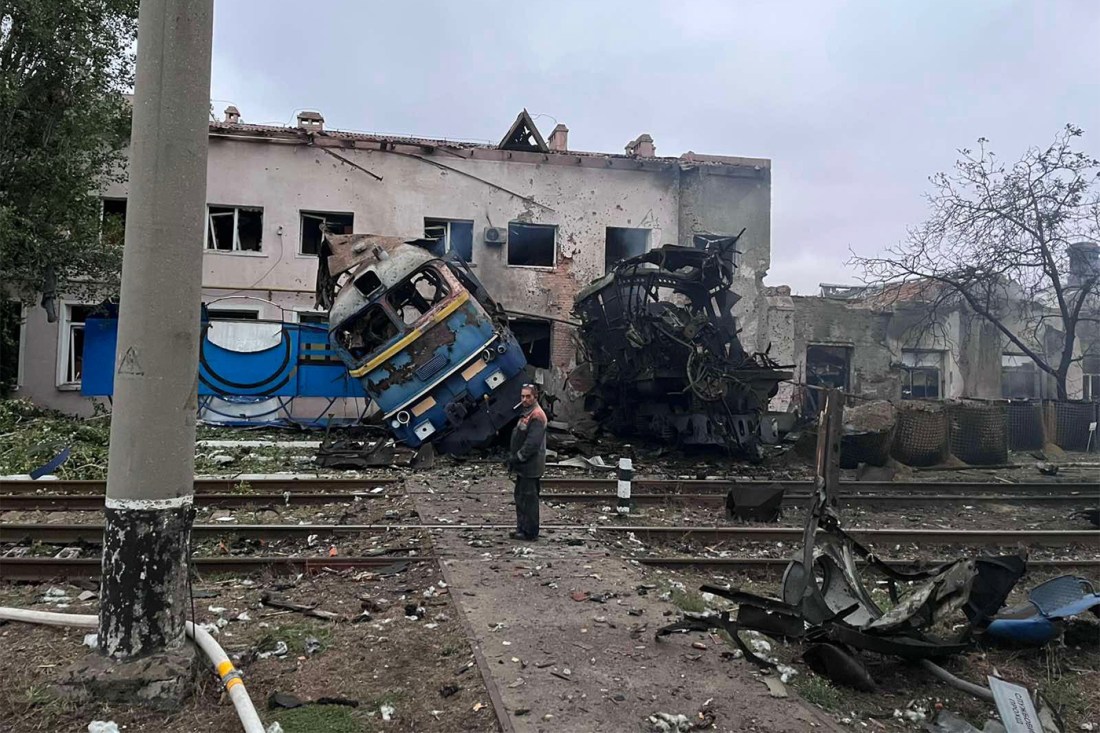
Sarwar, an associate professor in information systems, says the impact on supply chains and particularly global food supply chains has been “devastating” as the logistics — ports, roads and railways — that are used to transport goods have been destroyed by shelling and missiles.
Moscow is, according to reports, frequently attacking the Ukrainian railway system as it looks to erode its use for Ukraine’s defense efforts while also attacking what has become a powerful national symbol of defiance.
The research has inspired Sarwar to look next at how artificial intelligence — something altogether harder to target with bombs and guns — could help restore supply chains for Ukraine and make them more resilient in the long term.
“I would like to look at how AI can possibly influence supply chains, especially in disaster-hit areas,” she says.
But even before AI assistance, Rye says the Ukrainian military resilience should offer encouragement that a post-war rebuild of Ukraine’s supply chains is possible.
“Unless the infrastructure is destroyed, there is still hope because they are still supplying something,” she says. “They’re not supplying the essentials for living, but they are supplying weapons and so the supply chain is still working — it is just being replaced by different materials.”