Tech employers in Vancouver build talent pipeline with immersive experience
BaseCamp Studio on Northeastern’s Vancouver campus places students in jobs that last weeks, not months, but students get deep professional skills while advancing back-burner projects for employers

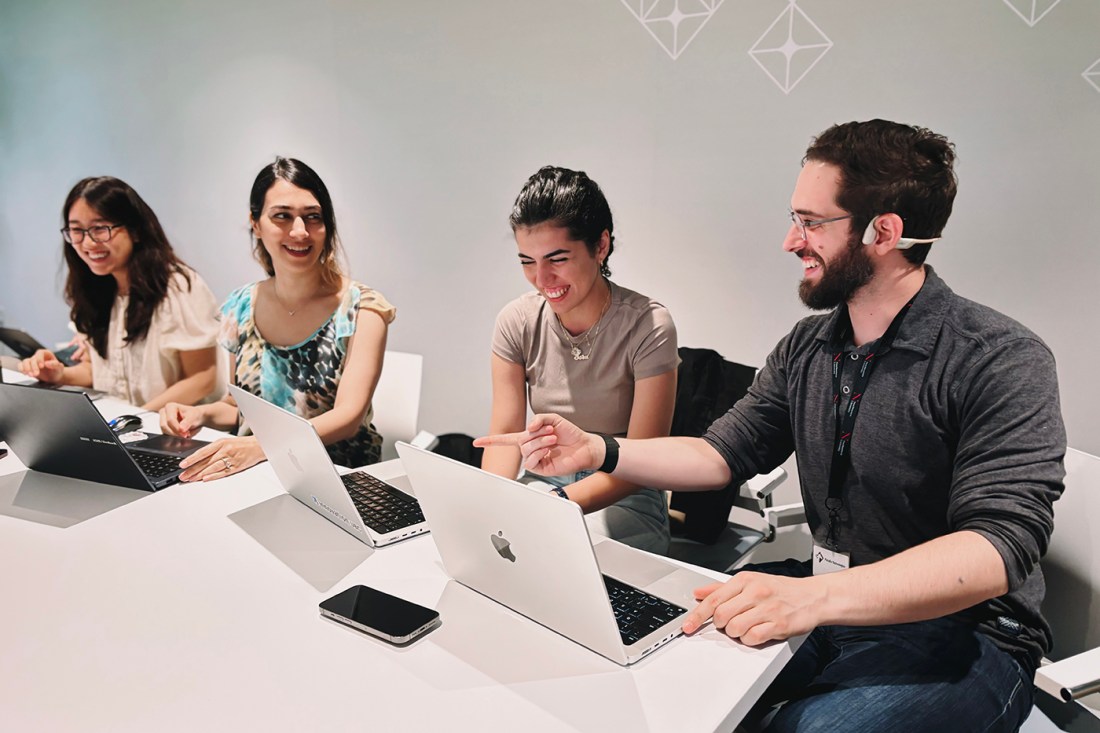
VANCOUVER, British Columbia — The eye-opening moment for computer science graduate student Sarah Liu was when she heard that the Chrome extension project she had worked on was going to market.
“That was very, very exciting to hear,” Liu says. “It confirmed my interest in software development, but it also got me interested in how products can be distributed to people so that they have more of an impact.”
Liu is one of 30 graduate students on Northeastern University’s Vancouver campus to participate in the first year of BaseCamp Studio, a new program that offers experiential work experiences similar to co-ops — but in weeks, not months. The students were hired to work in seven different partner businesses.
She worked for eight weeks over the summer with Traction Complete, an embedded partner in the downtown Vancouver building on campus. On a team with five other students, she tackled a research question: How good is AI-generated customer data?
“There are side projects that need to be done to answer certain research questions, but that we have difficulty justifying spending time on,” says Ernesto Valdes, chief technology officer for Traction Complete. “What we wanted to understand is, is that data any good? Do the models hallucinate and just tell you a bunch of lies?”

The company worked twice with Northeastern to hire students as part of the BaseCamp Studio program. Students in the first session designed an app that uses information from the Internet or training data to fill in accounts for about 10,000 companies on a spreadsheet. Valdes, who knew the quality of the data, compared what the students’ app delivered to his own data set.
The result? Good enough to be used in a new Chrome extension.
Since then, the company has developed a line of other features that wouldn’t have been possible without the work the students had done.
“What they did is they gave us a key to open doors and it’s very, very helpful,” says Valdes. Then, students in Liu’s group made the tool easier to use. The students delivered an app that provided customers with a clear understanding of what the company’s Salesforce applications do on the back end, he says.
“Every customer we showed it to wanted to buy our product, but they also wanted that Chrome extension,” he says. “They said, ‘I want this. I want this right now.’”
Liu entered the graduate computer science program after completing several tech-related internships. But even students with years of on-the-job skills under their belts describe BaseCamp Studio as a clinic in accelerated experiential learning.
“In my world, things are pretty technical,” says student Calvin Lo, who works as a senior process engineer at a medical device manufacturing firm. “I learned about what the implications are of selling software as a service as opposed to products. At the end of the day, it’s what customers actually need that guides the development.”
Editor’s Picks


Lo, who also worked at Traction Complete, says he was able to see how developers work with big code bases in a production setting.
“It was great to get exposure to that,” he says, “and to how software companies work without doing a co-op or getting another full-time job. This was a great compromise.
BaseCamp Studio is a learning model that fosters healthy competition between students who compete to enter a professional skills training program, says Vancouver campus dean Steve Eccles. After the training, students interview with industry partners for short, project-based jobs.
“We recognize that industry is dependent on super-fast innovation and a product sprint to market,” Eccles says. “BaseCamp Studio is the perfect catalyst to maximize our partners’ success, giving them access to exceptional student talent exactly when they need it, and that means invaluable experience for our students.”
Some employers use BaseCamp Studio as an efficient way to meet potential employees. InStage, which develops AI voice calls for higher education processes, hired a group of four students to investigate ways to extract phonemes from real-time audio.
“My biggest fear about a full semester co-op is that I won’t have enough bandwidth to give students a day-to-day experience,” says InStage co-founder and CEO Michael Caley. “What I liked about BaseCamp Studio was that it was a quicker preview to see if someone is going to be a team fit. If the purpose of co-op is to figure out who to hire, then this is definitely a more efficient way to do it.”
So far, 17 students have been hired to work on projects the companies might not have been able to complete without help. The employers say that Northeastern students have brought energy and talent to the short-term jobs, conceptualizing solutions to business challenges that might have lingered without the focused attention.
Northeastern Global News, in your inbox.
Sign up for NGN’s daily newsletter for news, discovery and analysis from around the world.
At Traction Complete, students met the company’s CEO and members of every team. They completed a tutorial on using the Salesforce platform and they shadowed a mentor for an afternoon, observing the person as they did their job.
“I was able to shadow one of the DevOps,” says Liu. “He spared an afternoon and showed me what it is like to do his work. It was a very exciting and beneficial experience.” She says she felt very prepared to work in a tech company. Before interviewing for the job, Liu competed to enter BaseCamp’s training program in which students dove into the basics of professional teamwork
“What I remember most vividly was giving and receiving feedback,” Liu says. “We learned how to influence a person without it becoming too personal. I used those principles to make sure everybody was aligned and on the same page.”
The training and work experience provide a big confidence boost for students who are new to professional settings. Snahil Dasawat entered the graduate program right after finishing his undergraduate degree. He worked on a data science project for Edusight, which develops tools for higher education institutions to communicate with students, helping gather and analyze data from student inquiries.
“I got the opportunity to connect with industry professionals. It was a strategically good program for me and it helped me enhance my overall personality apart from my technical skills,” he says. “It really helped me, you know, grow as a person.”