May I approach the bench? Federal court comes to Northeastern
In addition to tending to several cases during the ordinary course of business, the Tuesday morning session provided an opportunity for Northeastern law students to engage the federal judges in conversation.

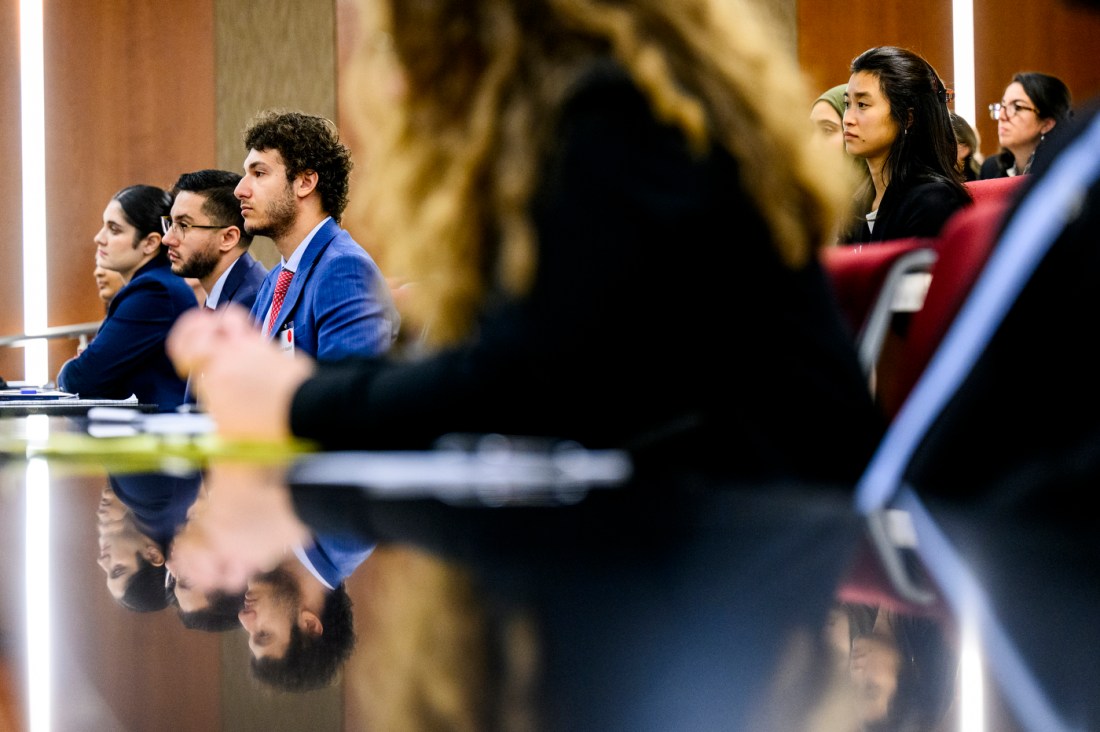
The U.S. Court of Appeals for the Federal Circuit heard arguments this week at Northeastern University’s School of Law, transforming Dockser Hall’s Moot Court Room into a temporary bench for federal court hearings.
In addition to tending to several cases during the ordinary course of business, the Tuesday morning session provided an opportunity for Northeastern law students to engage the federal judges in conversation — touching on everything from how to navigate the legal profession to the impacts of artificial intelligence on the industry.
“Because judges’ hiring decisions for clerks are so personalized, it’s always interesting to hear and get in the mind of a federal judge to know what they are looking for in a clerk,” says Carter Viets, a third-year law student who asked a couple questions.
Viets, 24, is currently an intern at the Court of Appeals for the First Circuit, which has appellate jurisdiction over Maine, Massachusetts, New Hampshire, Rhode Island and Puerto Rico. In addition to civil cases, the First Circuit also hears appeals in criminal matters.
Viets previously completed a co-op in the U.S. District Court for the District of Massachusetts, and another at a local law firm. He says this is his third opportunity to observe legal proceedings of this nature.
“It was cool to kind of see the differences between there, which is more constitutional and criminal appeals, whereas here it’s a lot more technical and specialized,” Viets says.
The Federal Circuit routinely hears arguments outside Washington, D.C., pursuant to its federal jurisdiction and legal mandate to provide “reasonable opportunities to citizens to appear before the court.”
Tuesday’s court filings and case briefs were available for the students to pore over.
After the court proceedings and the student Q&A, the students and School of Law faculty participated in a networking lunch with the three federal judges and their law clerks.
Editor’s Picks




The occasion was an opportunity ripe for experiential learning, says Lupita Colon, assistant director for judicial clerkship and public interest advising in the Center for Co-op & Career Development, who helped to organize the event.
The students got to see what effective public oral advocacy looks like up close, Colon says.
“Because they’re law students and they’re learning who they want to become and what kind of law they want to do, it’s helpful — especially if they want to go into litigation — to get to see what that advocacy looks like live,” Colon says.
Nadia Boudoukara, a third-year law student, sat with one of the judges during the afternoon lunch.
“It was great to listen to their takes on AI, the importance of the hiring process, and how judges and clerks interface with each other,” Boudoukara says.
Of the four cases argued on Tuesday, two of them concerned patent law — an area that interests Adam Zumbado, also a third-year law student.
“I came to law school to become a patent attorney, so this is right up my alley,” Zumbado says.
Zumbado, 30, is on track to graduate next year as a Double Husky after majoring in engineering as an undergraduate. He says his co-op experience helped open the door to several years of work as an engineer.
The advice Zumbado heard around the table during the networking lunch emphasized three key skills for aspiring lawyers: legal writing, oratory and networking.
“That first step out of school is pretty imperative,” Zumbado says.
Boudoukara says the judges spoke to the students about the importance of clerkship experience to any career in law.
Clerkships offer invaluable, hands-on experience with legal research, writing and decision-making, giving new or aspiring attorneys a peek behind the curtain of the judicial system.
They also expose graduates to a broad mix of real-world legal issues, from motions and trials to appellate arguments.
“The law clerks have such valuable advice, and hearing from the judges about what they look for in clerks — having these opportunities to directly interact with them is super helpful in terms of making decisions,” Boudoukara says.