Is the Super Bowl ready for Bad Bunny?
Bad Bunny will headline the Super Bowl halftime show, bringing Puerto Rican pride and political edge to the NFL’s biggest stage.

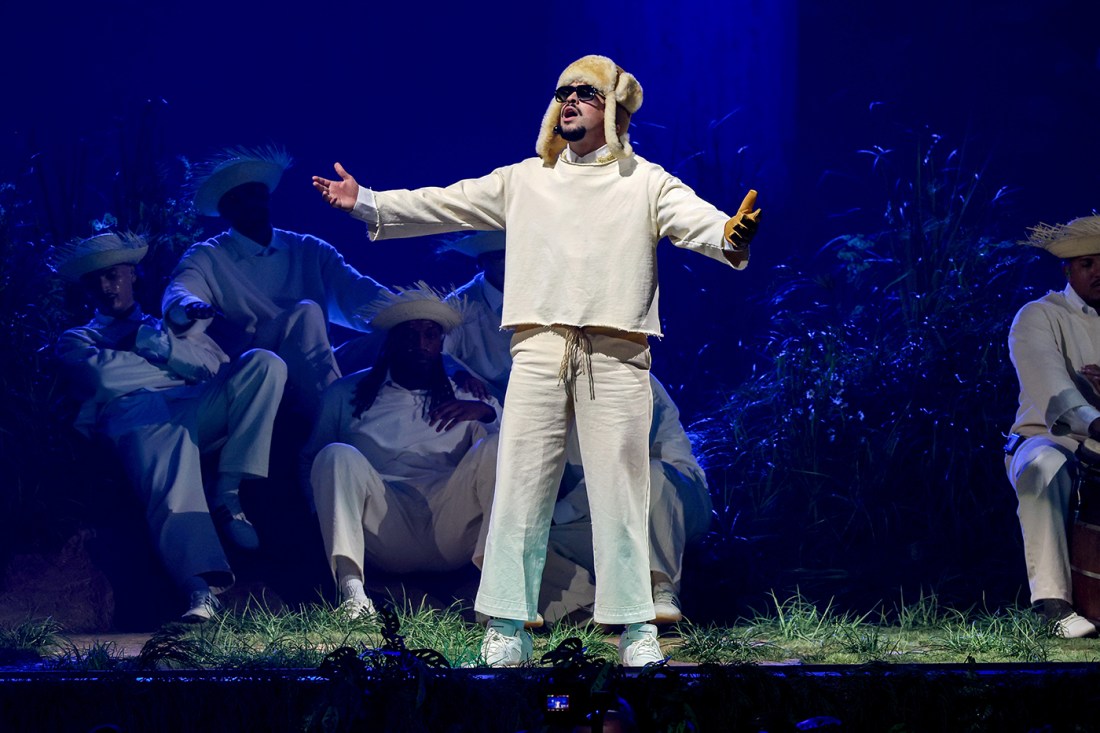
American football may not be as popular in Puerto Rico as baseball, basketball and boxing, but many more islanders are expected to tune in to the Super Bowl halftime show in February because of the headliner — Puerto Rican rapper Bad Bunny.
“Given Bad Bunny’s stature, there’s going to be a lot of people who will be watching who have no interest in football — just to see the spectacle,” says Amílcar Barreto, a native of Puerto Rico and professor of cultures, societies and global studies; international affairs; and political science at Northeastern University.
The National Football League made a bold commercial choice, he says, but it could backfire. The singer’s “unapologetically political” messaging might not sit well with the NFL’s current fan base, Barreto adds.
Bad Bunny, born Benito Antonio Martínez Ocasio, has made a meteoric rise. In 2016, he was bagging groceries in a coastal town near San Juan. Within a few years, he became an international rap star and the most-played artist on Spotify for three straight years between 2020 and 2022. He won Best Latin Artist at the 2020 Billboard Music Awards, and in 2022 became the first non-English speaking artist to win MTV’s VMA Artist of the Year. In early 2025, his album DeBÍ TiRAR MáS FOToS topped the global charts, reached No. 1 on the Billboard Global 200 and became the first non-English album with all its songs entering the Billboard Hot 100.
“If you’re thinking about music culture right now, he’s at the top of the summit,” Barreto says.
By choosing him for the halftime show, the NFL is trying to appeal to younger demographics, Barreto says, at a time when the demographic change is inflaming U.S. politics.
“A majority of elementary schoolchildren in the United States are now children of color,” he says. “So ‘the Brown wave’ is coming, and usually when something like that happens, you get a backlash.”
The NFL is betting not only on a popular Latino singer, but someone who performs mostly in Spanish and has an “unapologetically political” message, he adds.
“This is taking it to an entirely different level,” Barreto says.
In the NFL’s announcement, the rapper said this achievement was “for those who came before me and ran countless yards so I could come in and score a touchdown … this is for my people, my culture and our history.”
Editor’s Picks


This statement, Barreto says, shows Bad Bunny will not tone down his nationalism for the show, and his Puerto Rican pride might be seen by many as “un-American,” even though the natives of the island are U.S. citizens.
“I could imagine easily many devotees of the MAGA movement being quite upset,” he says. “It’s hard to predict. Will people in certain political circles begin to chastise the NFL for doing this, even trying to pressure the NFL to get rid of him? I could foresee that happening.”
In his work, Bad Bunny has made social commentary about women’s rights and sexism, homophobia, government corruption and social inequality, while also celebrating Puerto Rican resilience and calling attention to the island’s political status.
“He is absolutely, like so many other Puerto Ricans, fed up with the status quo, which increasingly many people are seeing as just a colony, and he is willing to criticize political leaders for being corrupt, regardless of which party they belong to,” Barreto says.
Puerto Rico became a U.S. territory in 1898 after the Spanish-American War. Because it is an unincorporated territory, residents’ rights are more limited than those of citizens in the 50 states. Islanders have no voting representation in Congress and cannot vote in presidential elections. Congress has the ultimate authority over the island’s governance, and a federal oversight board has been managing the island’s finances since 2016.
The central part of Bad Bunny’s message, Barreto says, is a mix of “be proud of who you are” and “we will resist,” which he and many other Puerto Ricans view as resisting the colonial status quo. The Super Bowl stage gives him a chance not only to entertain but also raise awareness about the island’s struggles.
The NFL announcement came shortly after Bad Bunny wrapped up his residency at José Miguel Agrelot Coliseum in San Juan. From July 11 to Sept. 20, he played 31 shows, closing with a livestreamed performance commemorating the eighth anniversary of Hurricane Maria.
By holding his residency in Puerto Rico during off-tourist season, Bad Bunny created a major economic boost of at least $200 million, according to Discover Puerto Rico. It is estimated that total spending, which included purchases not directly related to shows, will reach about $400 million, according to the New York Times.


