Exploring the role of women in supporting democracy: preliminary insights from Senegal, West Africa
“Senegal is one of Africa’s success stories,” says William Miles, a political science professor at Northeastern.

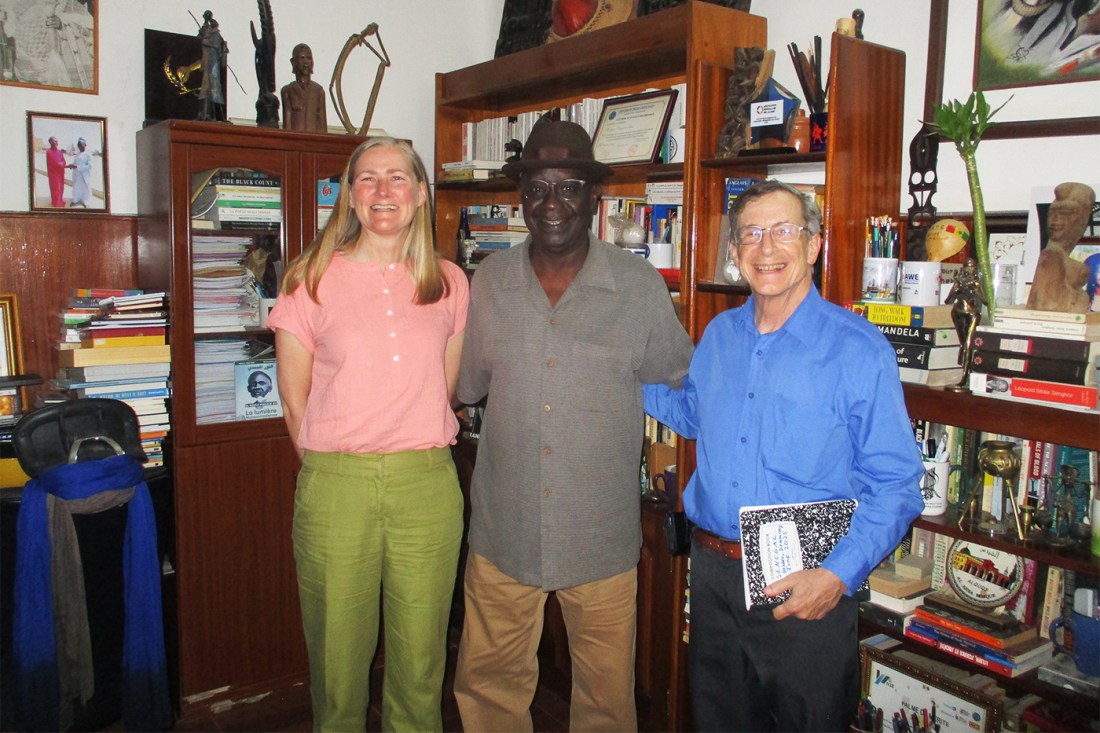
This past spring, William Miles and Martha Johnson set out on a collaborative study in West Africa to better understand the role of women in upholding democracy.
The trip, sponsored by the College of Social Science and Humanities as part of its initiative to encourage cross-campus research collaboration, focused on Senegal, which is often described as the poster child for democracy in a region otherwise subsumed in violence and upheaval.
“Senegal is one of Africa’s success stories,” says Miles, a political science professor at Northeastern.
“It is a positive outlier in the region. It’s been a continuous democracy since its independence in 1960, and it’s located in a region where neighboring countries have undergone military coups within the last several years,” Miles says. “That’s why it’s very important that Senegal retain its trajectory.”
The Sahel region, a 3,700-mile area that spans the Atlantic Coast to the Red Sea, has experienced a significant uptick in violence and instability since the collapse of the Libyan state in 2011.
Miles says the country has “symbolic importance for those Western nations who feel that democracy is the proper mode of governance in both the developing and developed worlds.”
Altogether, Miles’ stay in Senegal lasted from May 29 to June 15. An Africanist political scientist, he has traveled extensively across the African continent, including several stints in Niger.
Johnson, an associate professor of political science, spent the first week of June in Senegal, having studied there as an undergrad and conducted Ph.D. research there in the mid-aughts.
The pair conducted about a dozen interviews with Senegalese professors, leaders of development-focused NGOs and former politicians — including a former prime minister and a former vice president of the National Assembly.

“We went because we wanted to understand in the preservation of democracy, what is the role of women’s organizations,” Johnson says. “In West Africa — and Africa generally — when there was a push to democratize in the ’70s and ’80s, women’s movements were really at the forefront.”
The pair say that despite threats to democracy both regionally and across the world — due, in part, to the rise of authoritarian governments and the loss of Western humanitarian and counterterrorism support — women’s groups in West Africa remain engaged, and “are still at the forefront of preserving” democratic norms.
“What we found is that the women’s organizations often framed the push for democracy — at this point in Senegal — as a push for ‘ground-up citizenship,’ and rights and participation, and what we might call substantive or meaningful democracy,” Johnson says.
She continues: “Is [democracy] translating into other opportunities for women and girls? The women’s associations are really active at the ground level, getting people involved in local politics, solving local problems and opening up economic opportunities.”
Editor’s Picks





Last year, Senegal elected Bassirou Faye as its fifth president. Described as a pan‑Africanist and nationalist, Faye’s victory represents growing populist sentiment — particularly among Senegalese youth — centered around demands for economic sovereignty, political reform and an end to neocolonial influence.
“It’s part of this discourse that is spreading across West Africa that is anti-Western, anti-colonial, especially anti-French,” Johnson says.
“It’s the idea that Africa is being exploited, so you need to get rid of Western companies, renegotiate deals and pursue economic independence,” she says.
At the same time, strands of conservative nationalism have emerged in Senegal, particularly around issues of gender, inclusion and feminism. Johnson notes: “This is where we see parallels between how populism has developed in the West and the form of populist nationalism now taking shape in Senegal and across parts of Africa.”
In this context, it is noteworthy that Faye is the first Senegalese president to assume office with two first ladies. “Although permitted by Muslim and Senegalese law,” Miles observes, “up until now all past presidents had projected a ‘modern’ image by having only one wife.”
“But in our interviews,” he continues, “most women didn’t think there was any contradiction in combining progressive politics with polygamous marriage.”
Though it has its challenges, Johnson and Miles say it is notable how Senegal has worked to uphold democratic norms in the face of broader democratic erosion in the Sahel region. The region is home to a number of violent extremist organizations, and weakening international counterterrorism efforts in the region has led to an increase in weaponry and armed fighting.
Deaths related to militant Islamist violence in Africa have increased by almost 60 percent since 2021, with significant regional differences in threat levels, groups involved and their goals, according to the Africa Center for Strategic Studies.
“This is where you see the strongest Islamist movements, so it’s not a particularly stable region right now,” Johnson says. “This makes democratic Senegal an important beacon of stability.”
The pair intend to publish their findings at a later date.