Will Trump and Putin’s Alaska summit succeed without Ukraine or the EU?
Trump aims for a deal seen as good for both Russia and Ukraine, but success is uncertain, Northeastern expert says.

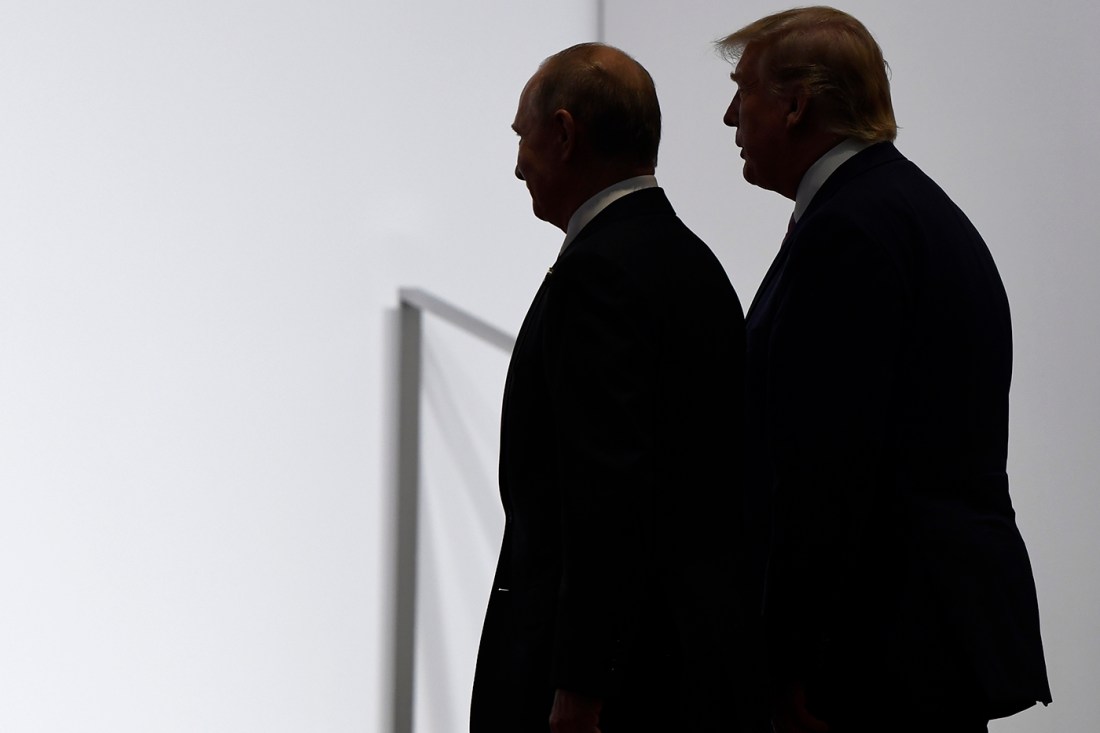
U.S. President Donald Trump and Russian President Vladimir Putin are holding a high-stakes Alaska summit without Ukraine or the European Union at the table — a move experts say could make it harder to achieve a lasting peace in the war.
“Not having Ukraine in the negotiations, not having the EU in the negotiations … raises big questions about whether the negotiations will ultimately be successful and whether they can come up with something that would bring Ukraine and Russia to the [negotiation] table,” says Julie Garey, a Northeastern University associate teaching professor of political science.
Trump will meet Putin on Friday in Anchorage. The meeting was announced last week as Trump’s deadline for Russia to commit to a ceasefire in Ukraine was expiring. Three previous rounds of Trump-facilitated talks between Ukraine and Russia this summer did not result in an agreement. Ukrainian President Volodymyr Zelenskyy, who has repeatedly emphasized Ukraine’s sovereignty and territorial integrity, will not be participating in the talks. However, Zelenskyy and European leaders spoke with Trump and Vice President JD Vance on Wednesday morning in advance of the summit.

Trump is entering the discussions confident in his ability to work directly with Putin, Garey says.
“President Trump feels very strongly that he is an excellent negotiator,” she says. “He sees Putin’s position or Zelenskyy’s position as maybe less entrenched.”
Trump hopes to find a resolution he can present as beneficial to both Russia and Ukraine.
“I think that that’s the goal that he has set out for himself,” Garey says.
She notes the administration may also be looking to strengthen the U.S. position in broader geopolitical negotiations.
Editor’s Picks





“Not very long ago, the Trump administration was talking about making deals to support Ukraine in exchange for rare earth minerals,” she says. “And they think in part that there’s some kind of economic or political settlement that could placate Ukraine, so the priority is to get Russia on board and then later deal with Ukraine.”
The Russian invasion of Ukraine in February 2022 occurred 8 years after Putin annexed Crimea, a peninsula on the Black Sea just south of Ukraine. The annexation occurred during President Obama’s administration.
“The Obama administration did not have a lot of success either in addressing Russian aggression in 2014, the annexation of Crimea,” she says.
Trump has acknowledged Putin’s history of breaking promises but remains committed to negotiating. He also has economic sanctions as a potential tool.
“There is always a belief that the U.S. still wields a lot of economic influence,” Garey says.
Reports from Russia, she notes, suggest the Russian economy is facing challenges that could affect public support for the war.
Putin is entering the talks with clear objectives, Garey says.
“He’s going in with a wish list,” she says. “He’s also going in with what he would see as minimally acceptable to move forward, and he’s going in with things that he absolutely would not agree to.”
Russia’s past conditions for ending the war have included major territorial concessions from Ukraine, demilitarization and neutrality, and security guarantees against NATO expansion.
“Putin has played his cards close to the chest,” Garey says. “It’s really difficult to think about what he is going into this meeting wanting and whether Russia has conceptualized what a longer peace would look like.”
Russia now fully or partially controls Donbas, Kherson and Zaporizhzhia. Garey says it’s unclear whether Putin would accept autonomy for these areas with pro-Russian governments or seek recognition as Russian territory.
“There is not really a clearly articulated path for what would happen to people who reside in these regions … who don’t identify as ethnically Russian, who want to maintain their status as Ukrainian citizens,” she says.
Zelenskyy continues to stress Ukraine’s sovereignty and adherence to international law.
“Principles of sovereignty, autonomy and territorial integrity are still very important to Ukraine,” Garey says.
The European Union, also not included in the Alaska summit, is expected to communicate its concerns to the U.S. ahead of the meeting.
“The EU has suspended relations with Russia,” Garey says. “But the EU member states and NATO need to articulate their needs in this agreement not only because they maintain support for Ukraine, but also because they share concerns about something similar happening in the future to Poland, Latvia, Lithuania, Estonia, even Sweden and Finland.”
Europe, she adds, remains committed to backing Ukraine in a settlement it finds acceptable.
“Europe is more inclined than the U.S. currently to say this really needs to be something that is mindful of Ukraine’s needs now and in the future and not that it is ceding territory or ceding resources to Russia for the sake of some kind of temporary peace or temporary cease-fire,” Garey says.