How Dean Thurman and his service puppies are supporting the Seattle campus community
Dave and Alison Thurman volunteer for Canine Companions, training puppies from eight weeks to 18 months and then handing them over for more specific instruction.

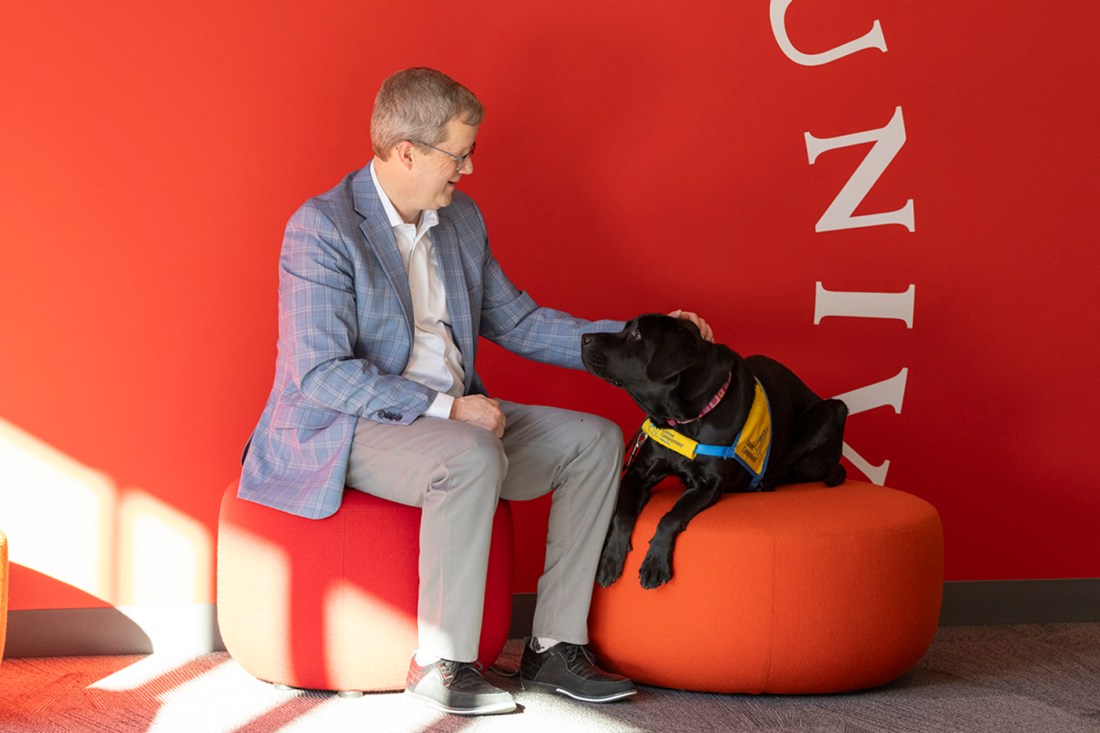
When people stop by Dave Thurman’s office, they might not be there to see the dean of Northeastern University’s Seattle campus.
Curled up under Thurman’s desk is Viola, a black Lab who — despite her visual impairment — is a trained therapy dog and can sense when someone is having a hard day.
“She interacts with staff every day,” Thurman says. “In a meeting, the dog decides they need to go and visit somebody, and after the meeting, the person will just say, ‘thank you. I really needed that.’”
Viola is Thurman’s pet now, but she didn’t start out that way. She’s one of seven Labradors he and his wife, Alison, have raised over the past 12 years to work as service dogs, supporting people with physical and developmental disabilities, hearing loss, PTSD and autism.
The Thurmans volunteer for Canine Companions, training puppies from eight weeks to 18 months before handing them over for more advanced instruction.
But when cataracts rendered Viola partially blind in one eye, the Thurmans got to keep her.
“Lap,” Thurman says, prompting Viola to spring up, her paws on his thighs. “There we go. Good girl.”
Thurman’s wife grew up with dogs, so when the couple married, it wasn’t long before they obtained their first Labrador. Over time, their household grew to include four dogs and two daughters. But they didn’t take in a service dog in training until they were down to just one pet and both children had left for college.
“We thought about getting another dog, and unbeknownst to me my wife had always thought raising a service puppy would be kind of a cool thing to do,” Thurman says.
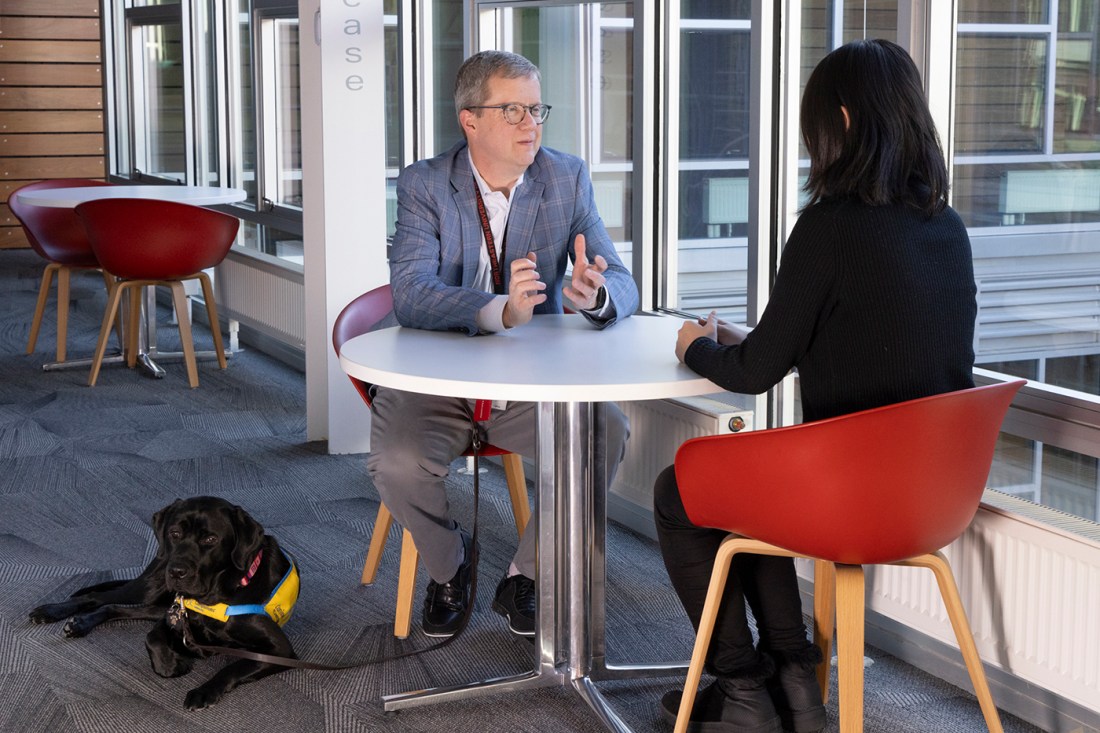
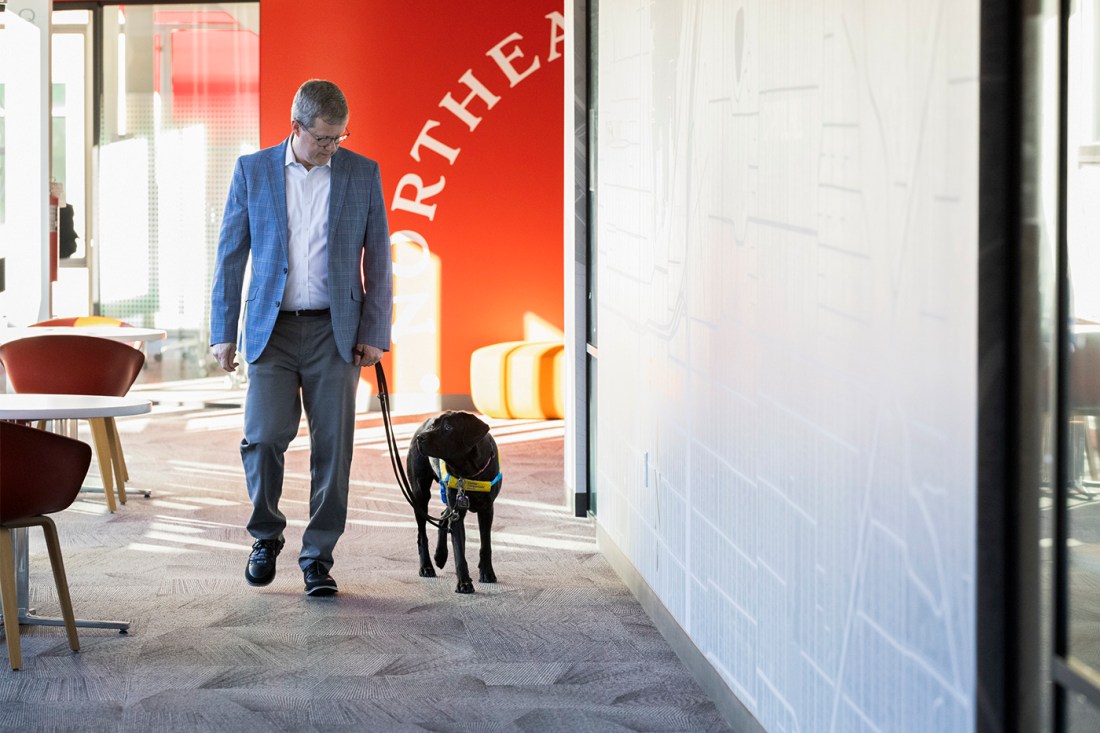
Raising a service puppy is much like raising a pet, except there are instructions — 175 pages of them. Dogs are trained to understand more than 40 commands, some of which overlap with standard pet training: sit, stay, shake.
But dogs like Viola also learn commands to assist people with disabilities: “Let’s go,” to move forward, and “visit,” to place their head on someone’s lap.
Commands can be combined for complex tasks. “Up” prompts the dog to place its paws on a counter or wall. Add “touch” and the dog uses its nose to flip on a light switch.
To turn the light off, replace “touch” with “shake,” and the dog uses its paw instead of its nose, Thurman explains.
Service dogs are also trained to sense when their help is needed. Dogs assigned to assist people who are deaf will nudge them on the thigh and guide them to the source of a sound, like a doorbell, smoke alarm or kitchen timer.
They can also support people with multiple disabilities. One of the dogs the Thurmans raised now assists a veteran with mobility challenges and PTSD. The dog picks up dropped items, unloads the dryer and wakes his owner from nightmares.
Another dog, Hamish, now lives with a boy on the autism spectrum. When the boy feels overstimulated, Thurman says, he lies down and tells Hamish to “cover.”
“The dog will come and put its entire body weight on you,” he says. “Hamish is an 80-pound weighted blanket, and for people who get easily overstimulated in certain environments, that can be a very helpful thing.”
The Thurmans don’t need to teach every command. After the dogs leave their care, they receive professional training tailored to the person they’ll serve. What matters most is that the puppies are well-socialized.
They bring the dogs to stores, baseball games, theaters and on airplanes. Even after advanced training, the learning continues.
“It’s not that they’re giving them a perfectly trained dog,” Thurman says. “They’re giving them what I would say is a perfectly trainable dog. They teach the recipient how to train the dog to do the things that they need to do, because every person’s needs are unique and they change.”
On campus, Thurman’s dogs have helped both staff and students. When he was new to the Seattle campus, a group of undergraduate business students from Boston came to visit. One student had always been afraid of dogs but wanted to overcome his fear.
At the time, Thurman was training a dog named Ashlyn and brought her in.
“Within an hour or so, he’s sitting on the floor with Ashlyn in his lap, tears streaming down his face,” Thurman says. “He was so happy because he had never been that close to a dog.”