Engineering fair highlights robust undergraduate research opportunities
A computer system that enables people in wheelchairs to turn left or right with their minds. Pens to help people with Parkinson’s disease steady their handwriting. Robots that test the strength of steel girders.
These are just three of the seemingly endless research opportunities for Northeastern undergraduates that were on display Monday evening at the College of Engineering’s Undergraduate Lab Fair.
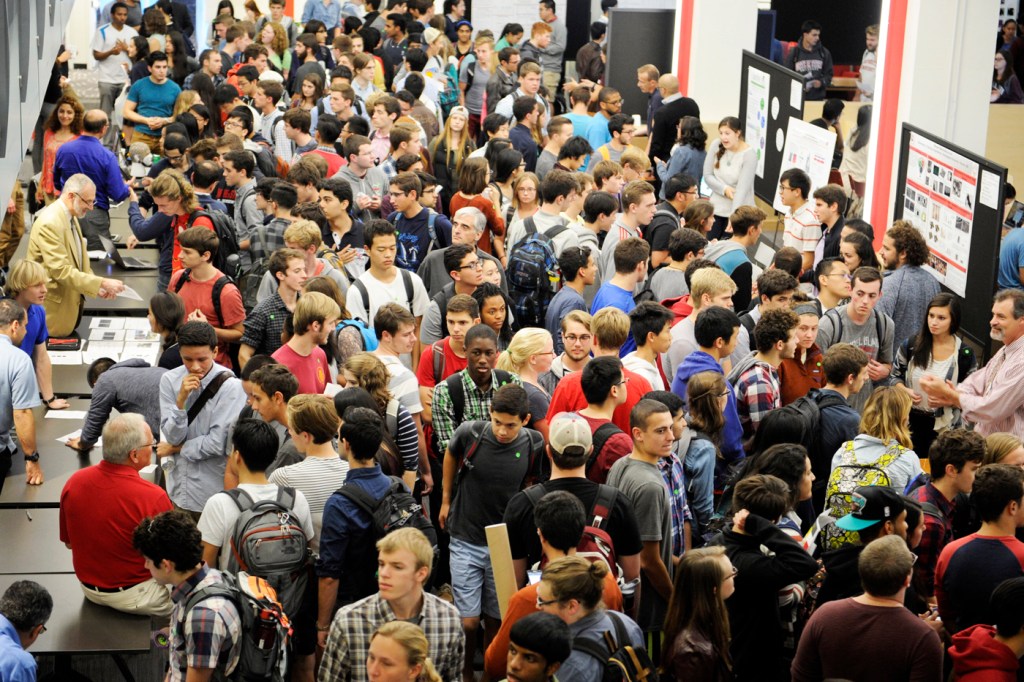
Some 550 students, packed wall-to-wall in the Curry Student Center Indoor Quad, eagerly engaged with faculty, research scientists, and fellow students representing nearly 30 labs to learn about projects covering fields from nanomedicine to environmental health, magnetic sensing to machine learning.
My peers at other colleges don’t have close to the opportunities available to them that we have here,”
—said Harry Brodsky, E’19.
Broadening horizons
Last year Brodsky worked in the lab of Sandra Shefelbine, an associate professor in the Department of Mechanical and Industrial Engineering, modeling crack propagation in animal bones. On Monday night he was looking in an entirely different direction: He was talking to associate research scientist Ljiljana Rajic about student openings on projects in the university’s Puerto Rico Testsite for Exploring Contamination Threats Center, also known as the PROTECT Center and based in the Department of Civil and Environmental Engineering. There, researchers use electrochemical processes to eliminate contaminants in groundwater found in Puerto Rico that can lead to preterm births.
Kaidi Du, E’16, stood not on the viewer but the presenter side of a display table, pointing to the poster she’d designed to describe her senior honors project in electrical engineering. “Have you heard of Stephen Hawking, the theoretical physicist with ALS?” she asked. The familiar frame of reference immediately drew listeners into the sophisticated research Du has been conducting in the lab of assistant professor Marvin Onabajo, in the Department of Computer and Electrical Engineering.
Du has developed an improved filter for the type of EEG, or electroencephalogram, system that enables people with ALS and other diseases to speak using brain waves. “The EEG system gave Hawking a new voice,” said Du. Such systems, housed in a device on the user’s head, record the brain’s electrical patterns. “But the signal is very weak,” said Du, “and the power line for the EEG has a lot of interference.” Her technology takes existing systems to a new level by filtering out that interference.

Photo by Matthew Modoono/Northeastern University
Growing as a student, growing as a scientist
Across the room, Julietta Moradei, E’16, described the work she’s been doing in the lab of Jerome F. Hajjar, CDM Smith Professor and Chair of the Department of Civil and Environmental Engineering. Since joining the lab the first week of her freshman year, she has advanced from working on literature reviews about structural engineering to testing “all kinds of materials” in Northeastern’s STReSS Laboratory, or Laboratory for Structural Testing of Resilient and Sustainable Systems, which is based at the university’s George K. Kostas Research Institute for Homeland Security in Burlington, Massachusetts.
They include compression tests and tension tests on huge beams, “big pieces of steel you would never see in a real-life situation,” said Moradei, who was also one of the student speakers at the President’s Convocation earlier this month. “You squash them, pull them, to test their strength.” As a senior, she’s circled back to her first hands-on project: figuring out ways to prevent buildings from losing heat. But now she’s actually prototyping the materials themselves. “Think of a building,” she said. “It’s mainly steel and concrete. We want to start bringing in plastics, because plastics will prevent that energy transmission.”
Developing products
Moshe Ohayon E’17, like many people, knows someone with Parkinson’s disease. That’s what brought him to the lab of associate professor Rifat Sipahi, in the Department of Mechanical and Industrial Engineering, last year. But few people are developing products to help those with the hand tremors that can come with the disease.
Ohayon is part of a research group designing an innovative pen that will steady the handwriting of people with “essential tremor,” a characteristic of Parkinson’s. At the fair, Siri Belton, a graduate student in mechanical engineering, held up a prototype of the pen that she had crafted using 3-D printing; it’s made of corn-based plastic—“a green product,” said Ohayon proudly.
His research experience has progressed from the ground up: At first he analyzed the handwriting of people with Parkinson’s by examining the density of the ink in the words they wrote. Input into Belton’s development of the pen followed: The pen’s cylinder-like stem makes it easy to grasp, and its attached motor helps writers get back on track should their trajectory veer off course.
Around the corner, Trevor Holbrook, E’19, stood in front of a computer screen showing a video of a man in a wheelchair smoothly negotiating his way around objects. For a joint project for the labs of Deniz Erdogmus, Taskin Padir, and Gunar Schirner, all of whom are associate professors in the Department of Electrical and Computer Engineering, Holbrook has been sharpening his Linux coding to help develop brain computer interfaces that permit people who can’t move on their own to communicate with the external environment using brain signals.
Holbrook, who’s been with the project for just three months, has been working on a computer network that enables that negotiation. “We specialize in taking brain signals and directing them to interact with the computer,” he said, pointing to four LEDs, or light-emitting diodes, planted on the corners of a small screen; LEDs are used to light up screens, including flat-panel computer monitors and TVs.
Each LED blinks at a different frequency, and each frequency represents a different command, such as “go forward,” “turn right,” or even “go to the bedroom.”
“We take brain-signal measurements from the back of a person’s head—where the visual cortex lies—to determine which frequency of LED the person is looking at,” said Holbrook. “The computer reads those signals, knows which LED the person is looking at, and automatically navigates the wheelchair according to the command that corresponds with the frequency.”
Becoming leaders
Research experience isn’t the only benefit of joining an engineering lab as an undergraduate, said Trevor Oxholm, E’18, who works in the lab of Nian X. Sun, a professor in the Department of Electrical and Computer Engineering. Oxholm helps with measurements and data analysis in the field of spintronics, which is “a new way of doing electronics based on quantum mechanical properties,” he said. Among its advances, “it promises more reliable memory storage in computers.”
By having to understand every part of a project, no matter how small, Oxholm said, he’s been exposed to both the rewards and the subtleties of doing science. “Doing this research has given me experience in leadership,” he said. “I’ve gained a lot of practice in learning how to implement what other people have worked on.”