A simulation game to help people prep for court
Preparing for court and appearing before a judge can be a daunting experience, particularly for people who are representing themselves because they can’t afford a lawyer or simply don’t know all the ropes of the legal process.
That’s why an interdisciplinary team of Northeastern faculty, staff, and students from the School of Law, the College of Arts, Media and Design, and the College of Computer and Information Science is developing an online simulation that would provide self-represented litigants with advocacy experience before they appear in court for real.
The simulation game is particularly targeted to the growing number of people who cannot afford legal representation and thus represent themselves in legal proceedings ranging from evictions and mortgage foreclosures to child custody proceedings and debt collection cases. Nationally, more than 80 percent of people with legal problems must resolve them without the assistance of a lawyer. When a dispute lands in court, people without any legal training find themselves addressing a judge, questioning witnesses, and offering documents into evidence.
The simulation game would let individuals try out these kinds of experiences in a virtual world before they appear in an actual courtroom. It would ultimately be made available online for free.
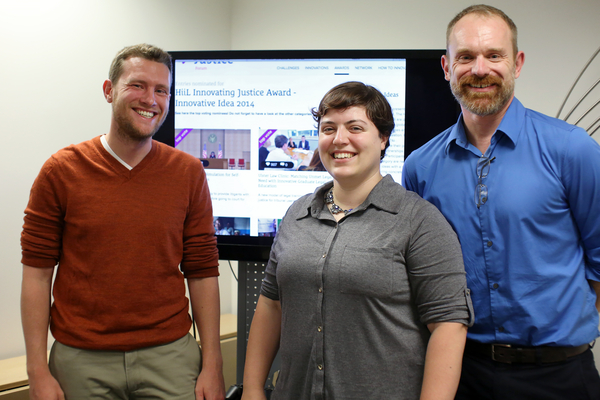
“This is the beginning of something that could be transformational in the legal system,” said Dan Jackson, executive director of the NuLawLab. Jackson and NuLawLab faculty director Martha Davis are leading the project for Northeastern in tandem with assistant professors Casper Harteveld and Gillian Smith, who work in Northeastern’s Playable Innovative Technologies Lab. Law students enrolled this winter in a newly created lab seminar on applied design and legal empowerment will also be involved in the project, which officially begins Jan. 1.

Courtesy of Casper Harteveld.
The project was one of 17 worldwide nominated by the Hague Institute for the Internationalization of Law for its Innovating Justice Award – Innovative Idea 2014. Earlier this month, the Northeastern “virtual courtroom” project received the most votes (988) of the nominees and will now have a shot at being named a finalist for the award in November at the institute’s Innovating Justice Forum in the Netherlands.
The Northeastern team will work with project lead Statewide Legal Services of Connecticut and New Haven Legal Assistance. The project has already received funding through the Legal Services Corporation’s Technology Initiative Grants program.
The project builds upon the NuLawLab’s work exploring new ways of delivering legal assistance and education to lawyers in order to provide more people with access to their legal rights. It also continues Harteveld and Smith’s “citizen science” projects in which the users themselves can contribute to scientific research through these game-based platforms. They are developing a game called “Mad Science” that aims to foster a culture of curiosity and learning by allowing users (the “mad scientists”) to create their own virtual experiments and recruit friends to participate.
In addition to providing self-represented parties with foundational advocacy experience, project leaders said the “virtual courtroom” would help build a community of support around these people’s needs. They envision users eventually being able to communicate with each other, share their courtroom experiences, and help first-timers navigate the process.
The team said community participation is both a unique aspect and a driving force of the project. Northeastern will lead collaborative design workshops attended by community stakeholders, including judges, court clerks, attorneys, people who have already represented themselves in court, and those in the midst of doing so. Researchers will gather information and feedback during the game’s testing phase and deployment, from which they will learn about how players respond in these virtual court situations—data that can be used to improve the simulation and to learn about human decision-making and community building.
“We will work closely with the community to design this game and maximize its impact,” Harteveld said.