Can’t quiet your mind? Watching your brain might help
A Northeastern researcher is using neurofeedback as a “mental mirror” to help people get the hang of meditation to manage or prevent mental health conditions.


When something in the human body goes awry, medical science has an impressive repair kit. Fractured leg? A cast will keep it intact until it heals. Cloudy eye lens? Doctors swap in a clear artificial one. A kidney that can’t filter blood? Dialysis temporarily outsources the job.
Mental health also has its go-to fix: a pill to lift a sinking mood, quiet intrusive thoughts or tone down hallucinations.
But why wait until the damage is done?
This thought kept nagging at Northeastern University professor Clemens Bauer Hoss as he was finishing his medical studies.
“Medicine is kind of just fixing things that are broken,” he said.
At the same time, could the mind play a bigger role in keeping the body and brain healthy — perhaps even before problems appeared?
That idea steered Bauer Hoss toward preventative medicine.
It’s also why he started meditating.
Years later, these threads came together in a program for treating mental health conditions such as depression and schizophrenia through meditation.
The thing is, getting a handle on your own mind is easier said than done.
“I really struggled,” Bauer Hoss said about his own experience. It took him almost two years to get the hang of the practice.
The struggle gave rise to an idea. “Maybe some feedback system, some mental mirror, could help people meditate a little bit better,” he thought.
That mental mirror was neurofeedback — a way to give people a sneak peek at the brain’s activity in real time so they can learn to change it.
The oldest form of neurofeedback uses electroencephalography (EEG), neuroimaging expert Vadim Zotev from the Mind Research Network, a nonprofit in Albuquerque, told Northeastern Global News.
By measuring the brain’s electrical activity through sensors on the scalp and translating it into a moving graphic or changing sound, this method responds in real time as you steer your brain activity in the desired direction. For example, an audio tone might rise or fall depending on how successfully you’re shifting your brain toward a relaxed state.
Real-time functional magnetic resonance imaging (fMRI) goes deeper, Zotev said.
You lie inside a narrow tube at the center of a powerful magnet that tracks which parts of your brain are receiving oxygen-rich blood, the magnetic properties of which distinguish it from oxygen-poor blood. Because areas of the brain active at a particular moment require more oxygen, the shifting signal serves as a log of brain activity during a particular task.
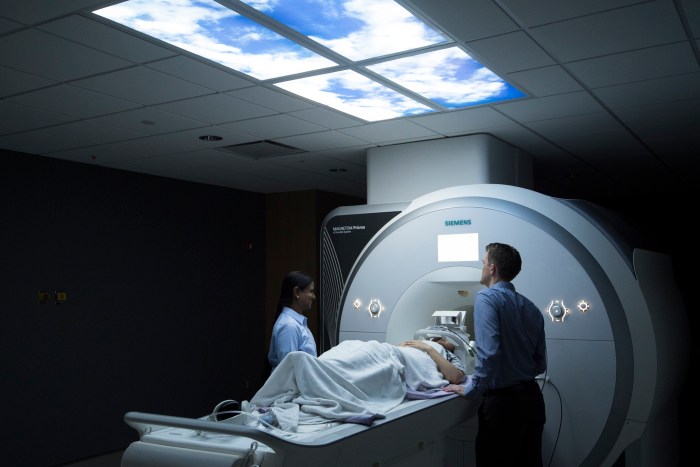
Bauer Hoss and his colleagues started by using fMRI-based neurofeedback to help people with schizophrenia learn meditation and have since expanded the approach.
Since everyone’s brain activity is unique, a diagnostic scan first gets the neurological lay of the land.
Bauer Hoss and his colleagues zero in on two specific networks. The first is the default mode network, or DMN, a collection of brain regions involved in inward, self-focused thought, or mental chatter.
The other area — the executive network — calls the shots when you make a decision, solve a problem or deliberately focus on your surroundings. It’s also active in meditation.
Editor’s Picks


Paying attention is hard work. Like a laptop slipping into energy saving mode, the brain is always looking for an excuse to wander off into the default mode network, Bauer Hoss explained.
In disorders such as schizophrenia and depression, the DMN can become dominant in two important ways. The regions within the network are more tightly connected. This means it can be hard for the brain to shift away from self-focused thought. It also kicks in during a wider range of tasks. For example, it might send your mind down a rumination rabbit hole when you’re trying to do a math problem.
Meditation — in this case, an exercise called the Noting Practice — aims to reel that wandering mind back in.
As you meditate in the scanner, a screen offers a play-by-play of the action in the brain. Two large circles represent the executive network labeled “focusing” and the DMN labeled “distracted.” A small white ball bobs up and down in response to your brain’s activity.
Hit the mindfulness sweet spot, and it climbs into the “focusing” territory. Let the mind wander, and it crosses over into “distraction.”
The goal is to get into the zone where activity in the DMN drops while the executive network ramps up.
“We call it effortless awareness,” Bauer Hoss said.
Effortless might be the goal, but it rarely feels that way at first. That’s why sessions are kept to a couple of minutes at a time.
“It’s like doing exercises with your mind, so it’s quite tiring,” Bauer Hoss noted.
Bauer Hoss found that schizophrenia patients with treatment-resistant hallucinations experienced a reduction in symptoms lasting for up to two weeks. In a group of adolescents, it dampened brain activity associated with depression. A current study with bipolar patients is showing promising results as well.
Having seen neurofeedback work in people battling an active condition, Bauer Hoss wants to go a step further.
Could it help those at high risk for psychiatric disorders — for example people with a close relative with schizophrenia — before symptoms appear?
Bauer Hoss has been testing whether mindfulness training with neurofeedback could act as a sort of “mental vaccine” for this group.
A recent study offers early support for the idea.
Bauer Hoss described it as a sort of fast-track course to get the feel for meditation. It facilitates the “mental click that has to happen in your mind” when you’re in the zone.
For all of its benefits, there are practical obstacles to fMRI neurofeedback. Machines are huge, expensive and limited to specialized facilities. And then there’s that narrow tube you have to lie in. It’s enough to make anyone with the slightest bit of claustrophobia think twice.
Bauer Hoss is currently working on a more portable alternative.
But the ultimate goal isn’t to keep people tethered to a feedback system forever.
“Once you know what you have to do with your brain, you don’t need the system anymore,” Bauer Hoss said.


